

 English
 Ethernet Cable
Home / Products / Ethernet Cable / CAT6 UTP LSZH Cable 23AWG 4 Pair 250MHz for Gigabit and PoE Structured Cabling

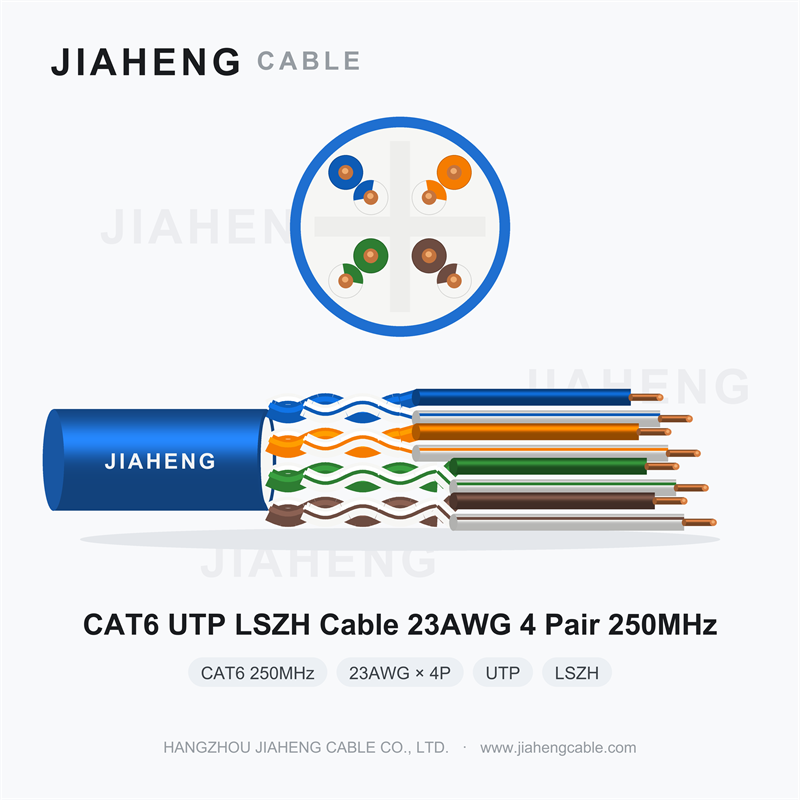
Confirmed Cable Specifications
• Category: CAT6 (Class E), bandwidth 250 MHz
• Ethernet application: 1000BASE-T (100 m); 10GBASE-T over shorter distances only (subject to standards, installation conditions, actual testing, and design calculations)
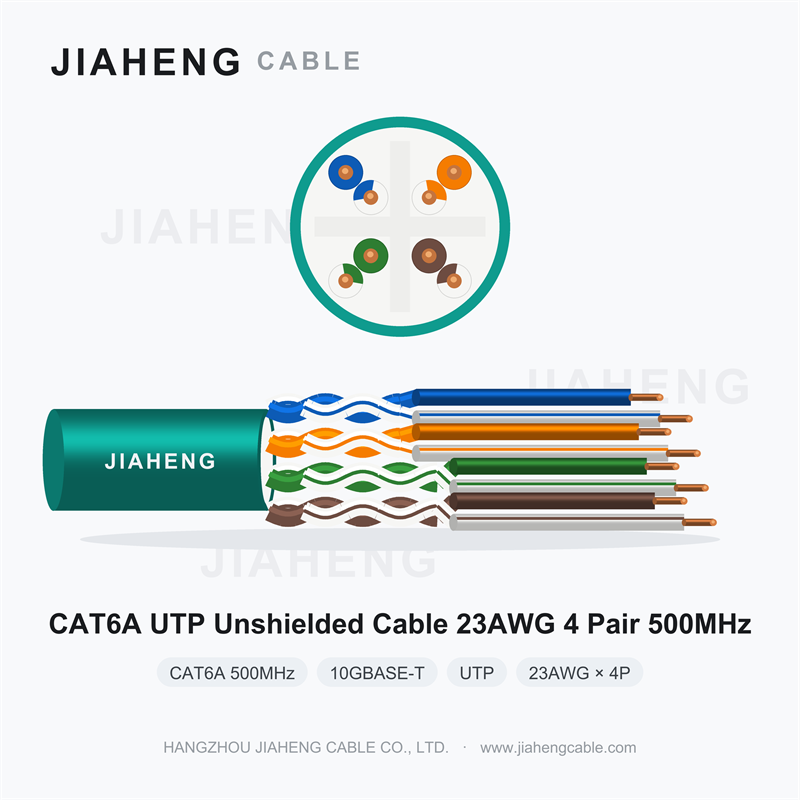
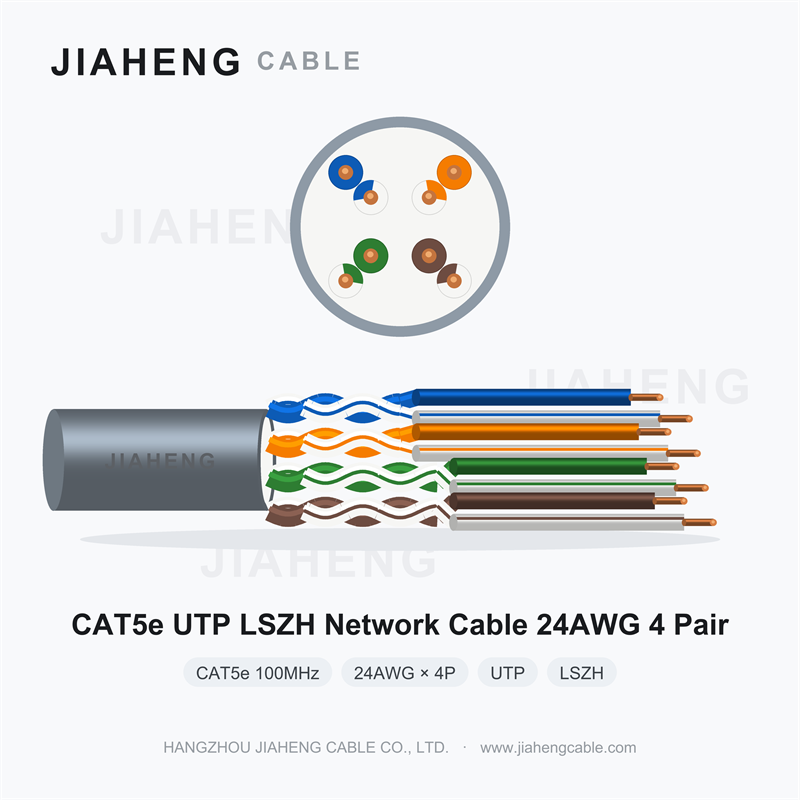
• Shielding: UTP (Unshielded Twisted Pair)
• Jacket: LSZH (Low Smoke Zero Halogen)
• Conductor size: 23AWG (approx. 0.57 mm diameter)
• Pairs: 4 pairs (8 cores)
1. Product Overview
CAT6 UTP LSZH 23AWG×4P is a four-pair unshielded data cable rated at 250 MHz, with 23AWG solid copper conductors and a Low Smoke Zero Halogen jacket. It carries 1000BASE-T Gigabit Ethernet over a full 100 metre channel with substantial margin above what the application requires.
That margin is the entire argument for CAT6. Where CAT5e at 100 MHz uses its bandwidth almost completely to deliver Gigabit, CAT6 at 250 MHz delivers the same application with room to spare. The practical consequences show up as better resistance to interference, more tolerance of imperfect installation practice, and a cable that remains usable if the network electronics at each end are upgraded later.
2. Bandwidth Headroom and Why It Matters on Site
Specifying a category above what today's application strictly needs is not over-engineering; it is an allowance for the reality of installation. A channel certified at its category limit is operating at the edge, where any additional degradation — a crushed section, an over-tightened tie, a slightly poor termination — can push it out of tolerance. Running the same application on a cable with 2.5 times the bandwidth means those inevitable small imperfections are absorbed rather than causing failures.
Contractors who have had to re-pull cable after a failed certification test understand the economics: cable is cheap, the labour to replace it is not, and the schedule impact is worse.
3. 23AWG and the PoE Reality
This is where CAT6 earns its keep in modern installations. PoE has moved from powering phones and access points to powering cameras, digital signage, lighting, thin clients and displays — and the power levels have risen with IEEE 802.3bt delivering up to Type 3 and Type 4 classes.
Two effects follow from conductor resistance, and both scale with it:
• Voltage drop. The powered device receives less than the sourcing equipment sends. Over long runs with high current, this can drop below the device's operating threshold, causing intermittent resets that are extremely difficult to diagnose because the data link itself is fine.
• Heating. Current through resistance generates heat inside the cable. In a bundle of many cables with limited airflow, that heat accumulates, raising conductor temperature, which in turn raises resistance further.
23AWG has roughly 20-25% lower DC resistance than 24AWG, and meaningfully lower than 26AWG. For installations carrying significant PoE, particularly in bundled configurations, the larger conductor is not a luxury — it directly reduces both problems. Where 802.3bt Type 3 or Type 4 loads are planned, confirm the bundle derating against the applicable installation standard and verify expected end-of-line voltage during design, not after commissioning.
4. 10GBASE-T: Read This Carefully
CAT6 is sometimes described as supporting 10 Gigabit Ethernet. This needs qualification. Under TIA guidance, CAT6 can support 10GBASE-T over limited distances — substantially shorter than 100 m — and performance is strongly affected by alien crosstalk between adjacent cables, which is why bundle size, cable spacing and installation care matter so much at that speed.
If 10GBASE-T to the outlet over a full 100 m channel is a firm requirement, specify CAT6A. If 10 Gigabit is a possible future need over short distances, or if Gigabit is certain and 10 Gigabit merely conceivable, CAT6 is a reasonable and cost-effective position. Do not let a datasheet claim substitute for a design decision made against the actual requirement.
5. UTP and When It Is Enough
Unshielded construction depends on pair balance rather than a metal barrier. In office, education, healthcare, retail and light commercial environments, where interference sources are ordinary building services, UTP at 250 MHz performs well and is faster and cheaper to install — no bonding, no earth continuity to verify, no risk of a screen that was specified but never terminated.
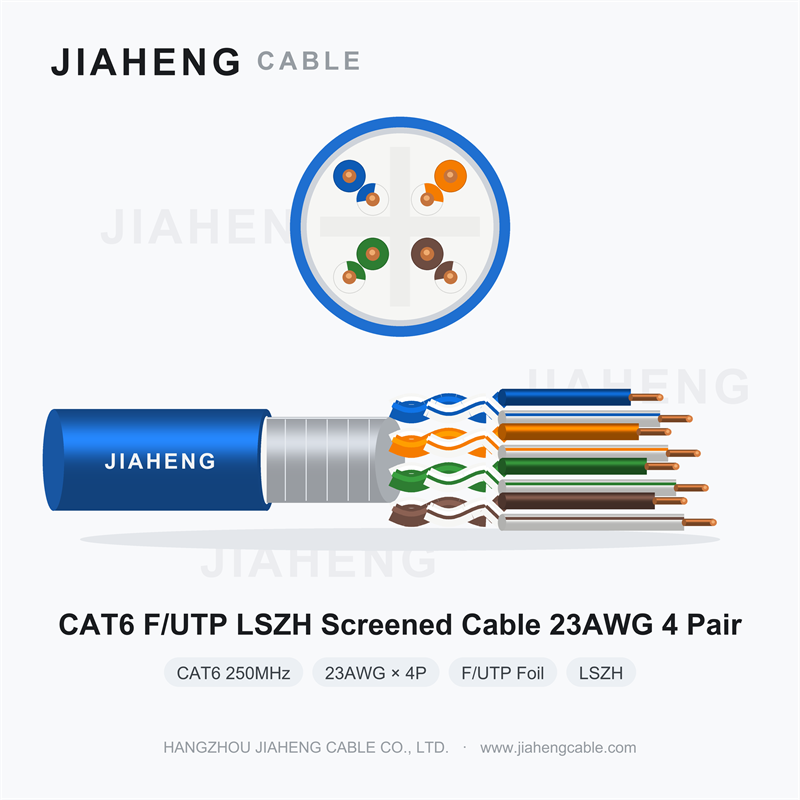
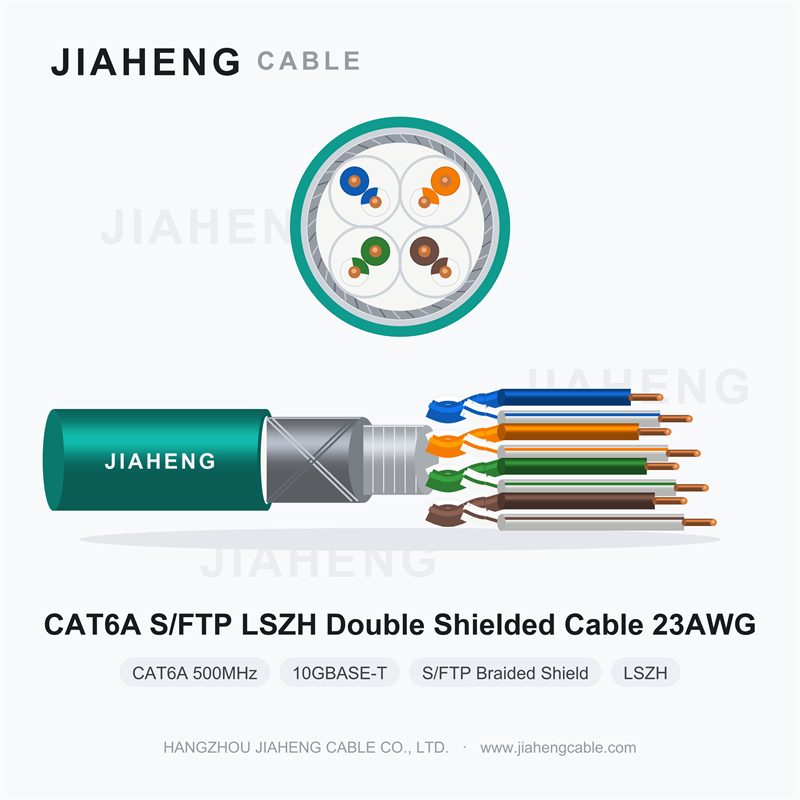
Reconsider shielding where the cable runs parallel to power feeders, serves industrial machinery with variable speed drives, or enters a location with strong radiated fields. In those cases F/UTP or S/FTP with proper earthing is the right answer; a screened cable installed without correct bonding is not.
6. LSZH Compliance
As with all LSZH products in this range, the jacket addresses fire safety in occupied and enclosed spaces. CAT6 UTP LSZH is a common specification for hospitals, schools, universities, airports, transport interchanges and high-rise buildings, where the permanent link is concealed above ceilings or below floors and the material requirement applies regardless of visibility. Request IEC 60754 and IEC 61034 test documentation for the supplied cable.
7. Applications
• Horizontal cabling in new commercial, education and healthcare buildings
• PoE-powered installations: IP cameras, access points, VoIP, digital signage, LED lighting
• Data centres for Gigabit access-layer connections where 10G to every outlet is not required
• Buildings with LSZH mandates
• Upgrades from CAT5e where additional margin is wanted without the cost of CAT6A
8. Ordering Guidance
Confirm conductor material (oxygen-free bare copper for permanent links), whether a cross filler is used, box length, printing and the LSZH test documentation supplied. For PoE-heavy projects, state the maximum intended load class and run length so the correct construction can be confirmed.
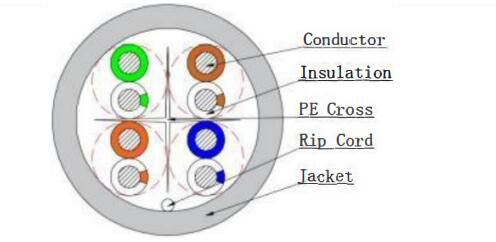
Technical parameter
| Type | CAT6 UTP 23AWG×4P |
| (mm) Specification | |
| Conductor | |
| Conductor material | BC |
| Conductor size | 23AWG×4P |
| ConductorConstruction(mm) | 0.53±0.01 |
| Insulation | |
| Insulation material | PE |
| Insulation diameter (mm) | 0.9±0.05 |
| AverageThickness (mm) | 0.18 |
| Min Thickness (mm) | 0.15 |
| Color | Blue, White-Blue, Orange, White-Orange, Green, White-Green, Brown, White-Brown |
| Fill | |
| Fill material | PE Cross |
| Rip-cord | |
| Rip-cord | Yes |
| Jacket | |
| Jacket material | LSZH |
| Jacket Diameter(mm) | 6.2±0.4 |
| Average Thickness(mm) | 0.55 |
| Min Thickness(mm) | 0.5 |
| Color | According to customer’s requirement |
Detailed technical parameters
| Type | CAT6 UTP 23AWG×4P | ||||||
| (mm)Specification | |||||||
| Electrical&PHsical Characteristic: | |||||||
| Conductor DCR 20℃ | ≤93.8 Ω/km | ||||||
| Characteristic Impedance(Ohm) | 100±15 | ||||||
| Operational Temperature | -20℃~+75℃ | ||||||
| Channel transmission performance(100M) | |||||||
|
Frequency (MHz) |
Attenuation (dB) |
NEXT (dB) |
PSNEXT (dB) |
ACRF (dB) |
PSACRF (dB) |
Return loss (dB) |
Delay (ns) |
| 1 | 2.1 | 65 | 62 | 63.3 | 60.3 | 19 | 580 |
| 4 | 4 | 63 | 60.5 | 51.2 | 48.2 | 19 | 562 |
| 8 | 5.7 | 58.2 | 55.6 | 45.2 | 42.2 | 19 | 557 |
| 10 | 6.3 | 56.6 | 54 | 43.3 | 40.3 | 19 | 555 |
| 16 | 8 | 53.2 | 50.6 | 39.2 | 36.2 | 18 | 553 |
| 20 | 9 | 51.6 | 49 | 37.2 | 34.2 | 17.5 | 552 |
| 25 | 10.1 | 50 | 47.3 | 35.3 | 32.3 | 17 | 551 |
| 31.25 | 11.4 | 48.4 | 45.7 | 33.4 | 30.4 | 16.5 | 550 |
| 62.5 | 16.5 | 43.4 | 40.6 | 27.3 | 24.3 | 14 | 549 |
| 100 | 21.3 | 39.9 | 37.1 | 23.3 | 20.3 | 12 | 548 |
| 200 | 31.5 | 34.8 | 31.9 | 17.2 | 14.2 | 9 | 547 |
| 250 | 35.9 | 33.1 | 30.2 | 15.3 | 12.3 | 8 | 546 |

 sales@jiahengcable.com
 +86-19357267601

 Heziwu, Shuangyuan Village, Linglong Subdistrict, Lin'an District, Hangzhou City, Zhejiang Province, P.R.China
Copyright © Hangzhou Linan Jiaheng Cable Co., Ltd. All Rights Reserved
