

 English
Industry News
Home / News / Industry News / FPLR vs. FPLP vs. LSZH Fire Alarm Cables: Fire and Smoke Ratings Compared

Content
Specifying fire alarm cable can look simple until a plan review asks why one run is FPLR, another is FPLP, and the specification also calls for LSZH. These labels are often treated as interchangeable, yet they answer different questions. FPLR and FPLP are cable listings tied to where a cable may be installed under the National Electrical Code. LSZH describes a jacket compound's smoke and halogen behavior. Neither label alone proves that a fire alarm circuit will keep operating during a fire. This guide separates the location ratings from the material claims and the circuit-integrity questions.
FPLR means Fire Power Limited Riser cable. It is a UL listing used for fire alarm and similar limited-power circuits, with a construction intended to limit fire propagation and smoke production in vertical riser applications. In practical terms, FPLR is the cable type commonly selected for floor-to-floor runs inside a shaft. It is not a plenum rating, and it should not be used in an environmental air space unless the cable also carries the required plenum listing or is installed in a code-compliant raceway system.
FPLP means Fire Power Limited Plenum cable. It is intended for ducts, plenums, and other environmental air spaces where smoke and flame spread would be especially undesirable. The listing requires the cable to demonstrate suitable fire-resistant and low-smoke characteristics for that location. FPLP is a location rating, not a statement that the cable is halogen-free, and not a guarantee of circuit integrity.
LSZH stands for low smoke zero halogen. It describes the jacket compound's performance: limited smoke emission and a low release of halogen acid gases when exposed to fire. LSZH is often requested for hospitals, schools, transit, data centers, and other occupied spaces. However, an LSZH cable still needs the correct FPLR, FPLP, or general-purpose listing for its installation location. "LSZH" on a datasheet is a material claim, not an NEC cable type.
The fastest way to read the three labels is to separate the installation location from the material and performance claims.
| Attribute | FPLR | FPLP | LSZH |
|---|---|---|---|
| Primary role | Riser fire alarm cable | Plenum fire alarm cable | Low-smoke, zero-halogen jacket |
| Code location | Vertical risers and permitted non-plenum runs | Plenums, ducts, air-handling spaces | Depends on the cable's FPLR or FPLP listing |
| Fire behavior | Limited fire propagation | More stringent flame and smoke performance | Varies with the complete cable construction |
| Smoke and halogen | Reduced smoke, not necessarily zero halogen | Low smoke, not necessarily zero halogen | Low smoke and low halogen acid gas |
| Circuit integrity | Not automatic | Not automatic | Not automatic |
| Main watch-out | Not a plenum substitute | Confirm the exact listing | Not a location rating |
"Fire resistance" can describe several different tests. For FPLR and FPLP, the emphasis is on flame spread, heat release, and smoke production in a defined installation location. That is different from circuit integrity, which asks whether a cable can continue to carry a signal while exposed to fire. Circuit-integrity ratings are addressed through tests such as UL 2196, IEC 60331, or BS 6387, depending on the project and jurisdiction.
NFPA 72 introduces another layer through pathway survivability. A designer may need a two-hour fire-resistive pathway, a listed circuit-integrity cable, a protective enclosure, or another approved method. An FPLR or FPLP marking does not, by itself, satisfy that requirement. Likewise, an LSZH jacket may reduce smoke and acid gas, but it does not make a cable fire-rated for circuit integrity.
FPLR is the normal choice for vertical risers that connect fire alarm control equipment, notification circuits, or detection loops between floors. If the shaft also functions as an air-handling space, the plenum rules may change the selection. The plans and the authority having jurisdiction should settle that question before procurement.
FPLP belongs in return-air ceilings, ducts, and other environmental air spaces. A low-smoke LSZH jacket may be desirable in these areas, but it is not a substitute for the FPLP listing. The cable should carry the required listing mark and be supported by the appropriate test data.
In occupied buildings, the specification may require LSZH for smoke and halogen control while still requiring FPLR or FPLP for the location. Hospital projects often combine these concerns because evacuation, continuous operation, and sensitive equipment all matter. A project-specific review is more reliable than choosing a cable from a single keyword. For healthcare layouts, the hospital industry solutions page can help frame the cabling discussion.
LSZH compounds are valuable where smoke opacity and corrosive halogen gases could complicate evacuation, damage electronics, or contaminate sensitive areas. They are not magic fire barriers. Smoke is still produced, and other combustion products can still be toxic. The jacket must also meet the mechanical and environmental demands of the route: temperature, sunlight, oil, abrasion, bend radius, and support spacing all matter.
For fire alarm circuits where an LSZH jacket is specified, the construction should match the circuit and the location. Jiaheng Cable's fire alarm range includes LSZH designs for notification appliance, conventional, and zoned detection circuits.
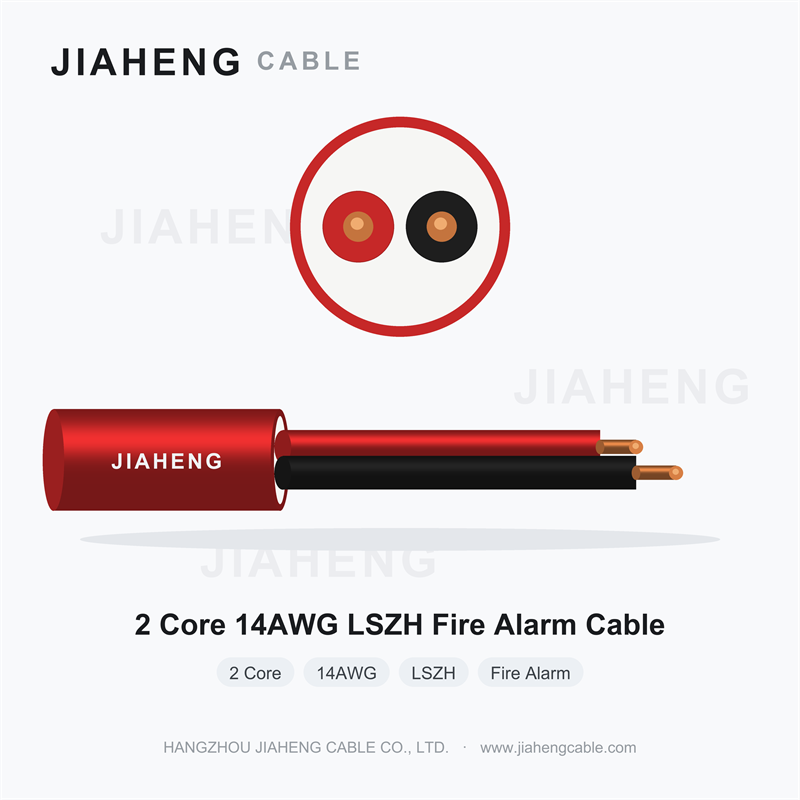 2-Core 14AWG LSZH Fire Alarm CableUnshielded two-core cable for notification appliance and sounder circuits, with an LSZH jacket for occupied and escape-route installations; verify conductor sizing.View Product →
That 2-core 14AWG LSZH construction is aimed at notification appliance circuits. Larger pair counts and different conductor gauges serve detection and zone wiring.
Use the following sequence to avoid a specification that sounds complete but leaves a code gap.
Where conventional zone wiring requires a four-core LSZH cable, selection should still follow the same order: location first, circuit second, material third.
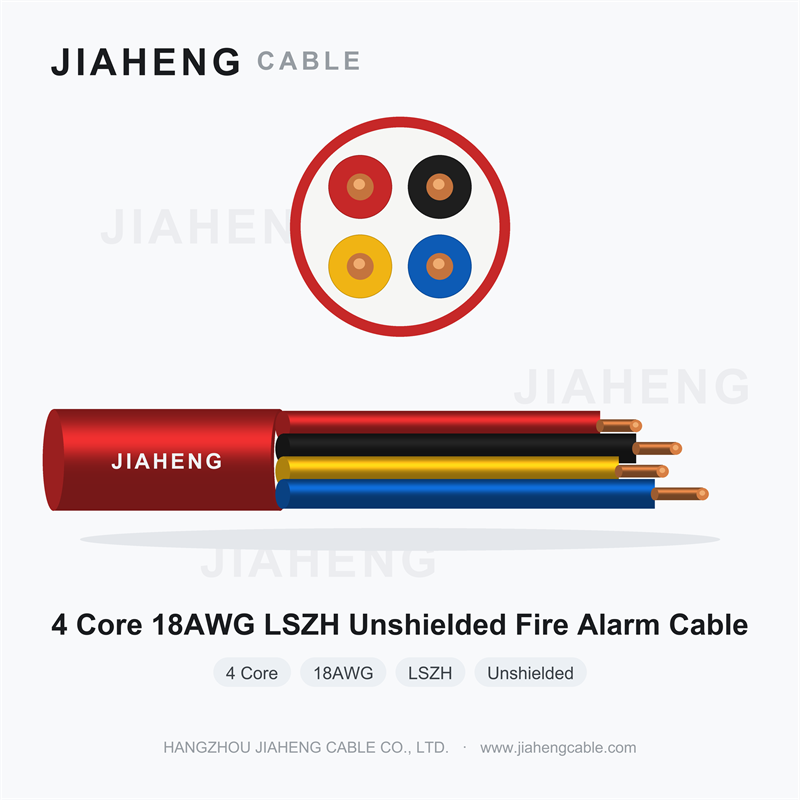 4-Core 18AWG LSZH Cable for Conventional Zoned DetectionFour-core unshielded cable for conventional zoned detection where two circuits share a route; verify loop resistance and voltage drop for 18AWG.View Product →
For multi-circuit zoned detection, a higher core count may reduce pulling complexity, but it does not change the location or survivability requirements.
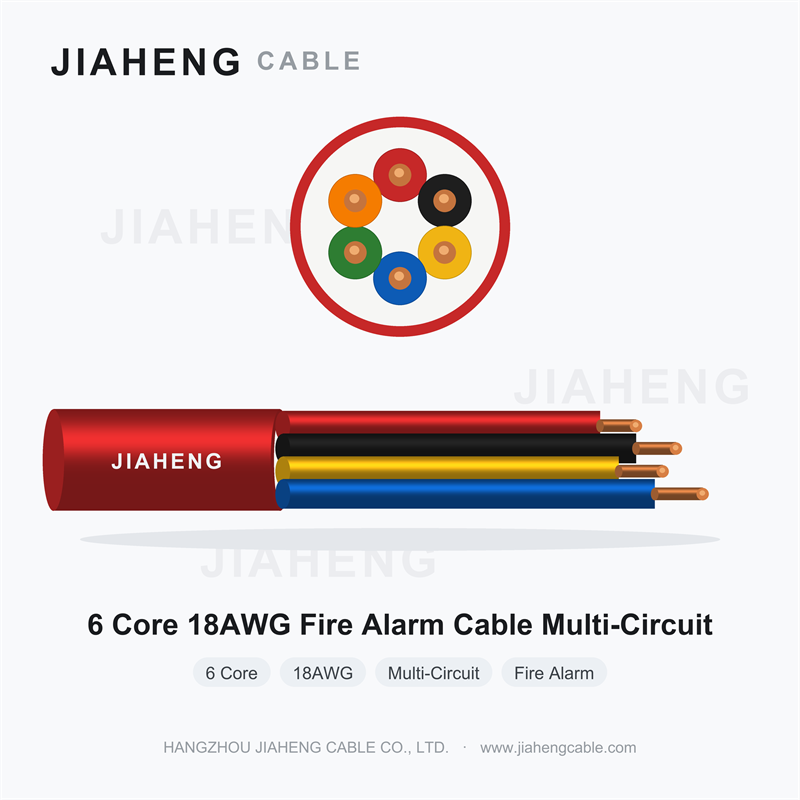 6-Core 18AWG Fire Alarm Cable for Multi-Circuit Zoned WiringSix-conductor cable consolidates multiple detection and control circuits in one run; 18AWG suits small-current signalling, with loop and voltage-drop checks.View Product →
Supporting standards and installation details are also covered in this guide to fire alarm wiring cable standards.
No. LSZH describes the jacket's smoke and halogen performance. A plenum installation requires a cable listed for the plenum environment, typically FPLP, unless the installation method provides an approved alternative. Always check the cable legend and the project code.
Generally, no. FPLR is a riser rating, not a plenum rating. A plenum or environmental air space normally calls for FPLP or another code-approved method. Local amendments and raceway provisions can affect the answer, so confirm with the authority having jurisdiction.
No. FPLP addresses flame spread and smoke for plenum locations. It does not automatically provide a two-hour circuit-integrity rating. NFPA 72 pathway survivability may require a listed fire-resistive cable, a protective system, or another approved design.
There is no single answer. The cable must satisfy the location listing, the circuit requirements, and any project requirement for LSZH. Many healthcare specifications combine FPLR or FPLP with LSZH. The final choice should follow the fire alarm design, applicable code, and submittal review.
Read the cable legend, the listing documentation, and the test reports. The legend should show the cable type required for the location. For LSZH, request smoke and halogen acid gas data, not just a marketing phrase. For circuit integrity, ask for the specific test standard and rating.

 sales@jiahengcable.com
 +86-19357267601

 Heziwu, Shuangyuan Village, Linglong Subdistrict, Lin'an District, Hangzhou City, Zhejiang Province, P.R.China
Copyright © Hangzhou Linan Jiaheng Cable Co., Ltd. All Rights Reserved Custom Industrial Wire and Cables Suppliers
