

 English
Industry News
Home / News / Industry News / Multi-Core Fire Alarm Cables: 2C, 4C, and 6C Wiring for Zoning and Notification

Content
Fire alarm systems are life safety networks, and the cable between the panel and field devices has to support more than current flow. Multi-core fire alarm cables with 2, 4, or 6 conductors give designers a compact way to organize zoning, notification, and detector circuits. The conductor count should follow the circuit function, not the other way around.
This guide explains how 2C, 4C, and 6C constructions are typically applied to zoning, speaker strobe circuits, and detector wiring, and it highlights the selection points that matter before a cable schedule is issued.
A multi-core fire alarm cable groups several insulated conductors under one jacket. That construction reduces the number of separate pulls, saves conduit space, and keeps related circuits organized at panels, junction boxes, and device plates. In a building with many initiating devices and notification appliances, that organization matters during installation, testing, and maintenance.
The jacket does not make the circuits interchangeable. Each conductor group still needs the correct supervision, identification, overcurrent protection, and separation from power circuits. Local fire codes and the project specification set the minimum requirements. Review fire alarm wiring standards together with the approved drawings and the authority having jurisdiction's comments.
The conductor count is only the package. Circuit function, voltage drop, and code listing decide whether that package is suitable.
Conductor count is a design result, not a product label. A 2C cable may contain one pair or two single conductors. A 4C cable may support two pairs, four individually functioning conductors, or a permitted combination of signal and power conductors. A 6C construction offers more conductors for grouped circuits, but the schedule still needs to state circuit purpose, conductor size, color code, and jacket or shielding requirements.
| Construction | Typical fire alarm role | Design notes |
|---|---|---|
| 2C | Simple detection zone, notification branch, or remote device | 18AWG is common for low-current detection; 14AWG is common for notification where voltage drop dictates. |
| 4C | Two related circuits, or a zone circuit plus a supervised signal circuit where permitted | Confirm circuit separation, identification, and supervision at both ends. |
| 6C | Multi-zone detection, grouped initiating circuits, or several low-current devices | Useful for consolidating home runs, provided the zone map and conductor identification remain clear. |
Three practical rules prevent most mistakes. Select conductor size from current, distance, and voltage drop, not from core count alone. Confirm that the cable construction is listed or approved for fire alarm use in the destination market. Keep the zone plan and conductor schedule consistent so a 6C cable does not become an unexplained bundle at the panel.
Zoning helps responders locate a fire or fault quickly, and it shapes the cable schedule. A conventional system may use one zone per home run, while an addressable system may use loops with devices grouped by floor, wing, or occupancy area. The cable should make the zone structure easier to trace, not harder.
A 4C cable can be useful when two related circuits follow the same route, such as two conventional detection zones. A 6C multicircuit cable goes further by consolidating several low-current circuits into one home run. For zoned detection, that can reduce conduit fill and termination time when the conductors remain clearly identified and the zone boundaries stay logical.
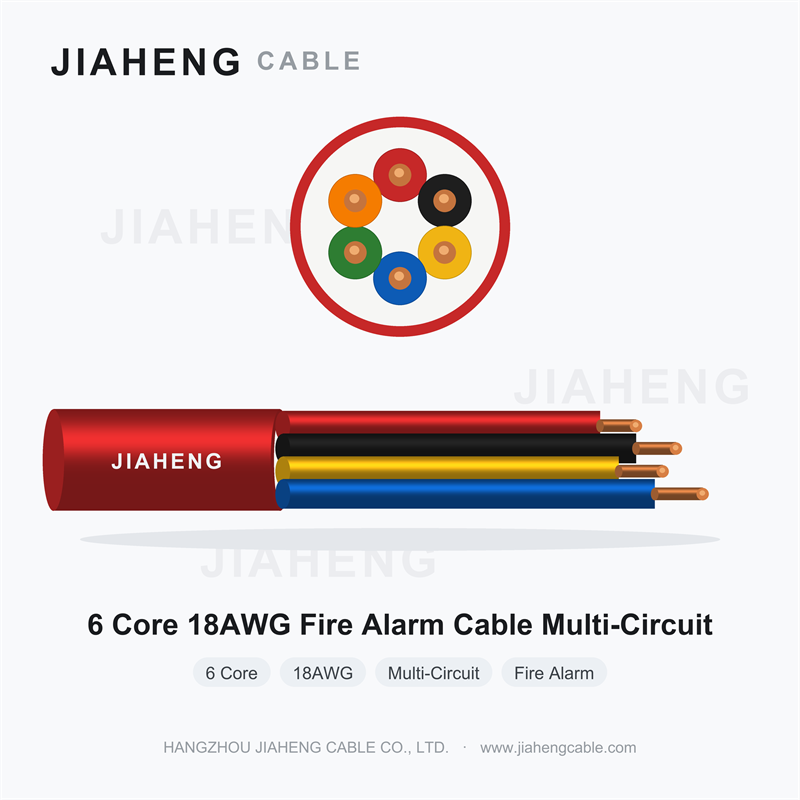 6 Core 18AWG Multi-Circuit Fire Alarm CableSix-conductor 18AWG cable consolidates multiple low-current fire alarm circuits into one sheath, reducing separate runs and containment space for zoned detection and control wiring.View Product →
Sharing a jacket is not the same as sharing a circuit. Conductors used for different zones should be identified at both ends and documented on as-built drawings. If the specification requires separate cables for survivability, power separation, or circuit integrity, a multi-core cable does not remove that requirement.
Notification appliance circuits often demand more attention to voltage drop than detector circuits. Speakers, strobes, and combination speaker strobes draw current that rises with device count and cable length. A 2C 14AWG cable is a common choice for notification branches because the larger copper area helps control voltage drop over long runs. The final size still depends on appliance current, circuit length, tap rules, and the manufacturer's instructions.
A 4C cable may appear convenient when a speaker pair and a strobe pair run to the same area. That arrangement is acceptable only where the circuit design, supervision scheme, and local code permit it. The circuits may need separate identification, overcurrent protection, or physical separation. Do not assume that one jacket allows one mixed circuit.
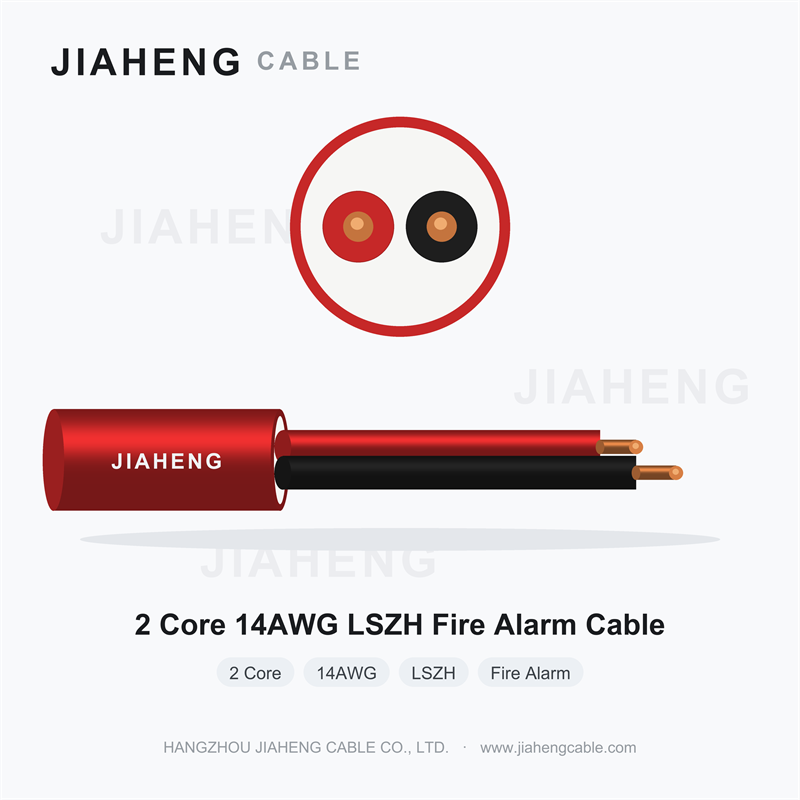 2 Core 14AWG LSZH Fire Alarm CableUnshielded 14AWG cable for notification appliance circuits and sounder loops, with an LSZH jacket suited to occupied buildings and escape routes.View Product →
Jacket material also matters in occupied buildings. Low smoke zero halogen, or LSZH, jackets are often specified for hospitals, airports, schools, and transport hubs where limiting smoke and corrosive gas is a priority. PVC jackets may be acceptable in other environments, but the project specification and product listing should decide.
Detector wiring includes smoke detectors, heat detectors, duct detectors, manual call points, and interface modules. Conventional systems generally use zone circuits that report an alarm by zone. Addressable systems use loop circuits that identify individual devices. Cable selection follows the system architecture: a conventional zone may use a 2C 18AWG cable, while a grouped detection layout may benefit from 4C or 6C construction when multiple zones share a route.
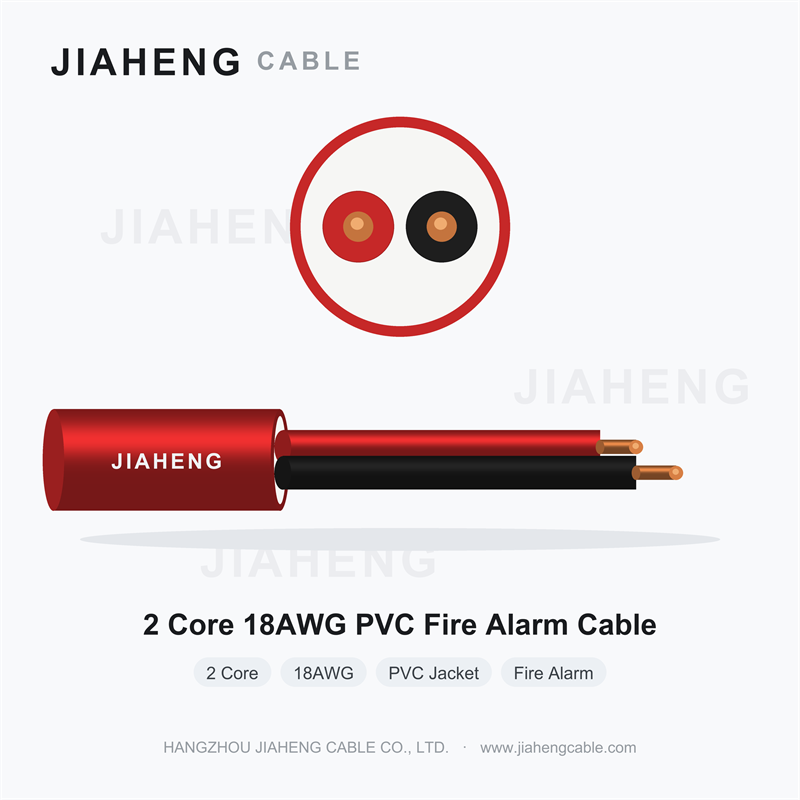 2 Core 18AWG PVC Fire Alarm CableTwo-core 18AWG PVC cable for detector branches, manual call points, and short signal circuits in plant rooms, basements, and other permitted non-public locations.View Product →
Addressable loops are not automatically a reason to use any convenient multi-core cable. Loop topology, impedance, capacitance, shielding, and device compatibility belong to the system design. A 2C cable does not fix a poor zone plan, and a 6C cable does not correct incorrect addressing or supervision.
Fire alarm cable selection usually comes down to conductor material and size, insulation, shielding, and jacket. Stranded copper is common for flexible pulls; solid copper is common for fixed runs. Shielding can help where electromagnetic interference is present, but it must be terminated and grounded according to the design. An unshielded construction is often sufficient in ordinary environments, while industrial areas with drives, welding equipment, or radio sources may need a screened design.
Installation practice matters as much as the data sheet. Keep bends within the manufacturer's radius, respect conduit fill, support the cable at required intervals, and separate fire alarm wiring from power circuits as the code requires. Leave enough slack at panels and device boxes for termination and service. In hospitals and other critical facilities, these details should align with the broader hospital industry cabling solutions and the facility's life safety plan.
When these steps are complete, 2C, 4C, and 6C cables become a deliberate part of the life safety design. The result is a system that is easier to install, inspect, and maintain over the life of the building.
2C cable contains two conductors and is commonly used for a single detection zone or notification branch. 4C cable contains four conductors and can support two related circuits or a permitted signal and power arrangement. 6C cable contains six conductors and is often chosen for multi-zone detection or grouped low-current circuits. The circuit design, conductor size, and local code determine the final choice.
It can be considered only when the circuit design, supervision scheme, separation requirements, and local fire code allow it. Speakers and strobes may need separate circuits or specific identification. Confirm the arrangement with the fire alarm designer and authority having jurisdiction before using one multi-core cable for both functions.
14AWG is common for notification appliance branches because it helps control voltage drop over distance. 18AWG may be used for lower-current detector circuits. The final size depends on appliance current, circuit length, device taps, and the manufacturer's instructions.
It can reduce the number of separate cables pulled through a raceway, but it does not automatically reduce the required conduit size. Conduit fill is calculated from the outside diameter and number of cables, plus applicable derating and installation rules.
LSZH is often specified in hospitals, airports, schools, tunnels, and other occupied spaces where limiting smoke and corrosive gas is important. PVC may be acceptable in other locations. The project specification, building code, and cable listing should guide the decision.
A 6C cable has six conductors, which may form three pairs or serve several individually identified circuits. The number of zones depends on circuit design, supervision method, conductor assignment, and code requirements. Six conductors do not always equal three independent zones.


 sales@jiahengcable.com
 +86-19357267601

 Heziwu, Shuangyuan Village, Linglong Subdistrict, Lin'an District, Hangzhou City, Zhejiang Province, P.R.China
Copyright © Hangzhou Linan Jiaheng Cable Co., Ltd. All Rights Reserved Custom Industrial Wire and Cables Suppliers
