

 English
 Ethernet Cable
Home / Products / Ethernet Cable / CAT6A F/UTP LSZH Cable 23AWG 4 Pair 500MHz for 10GBASE-T 10 Gigabit Cabling

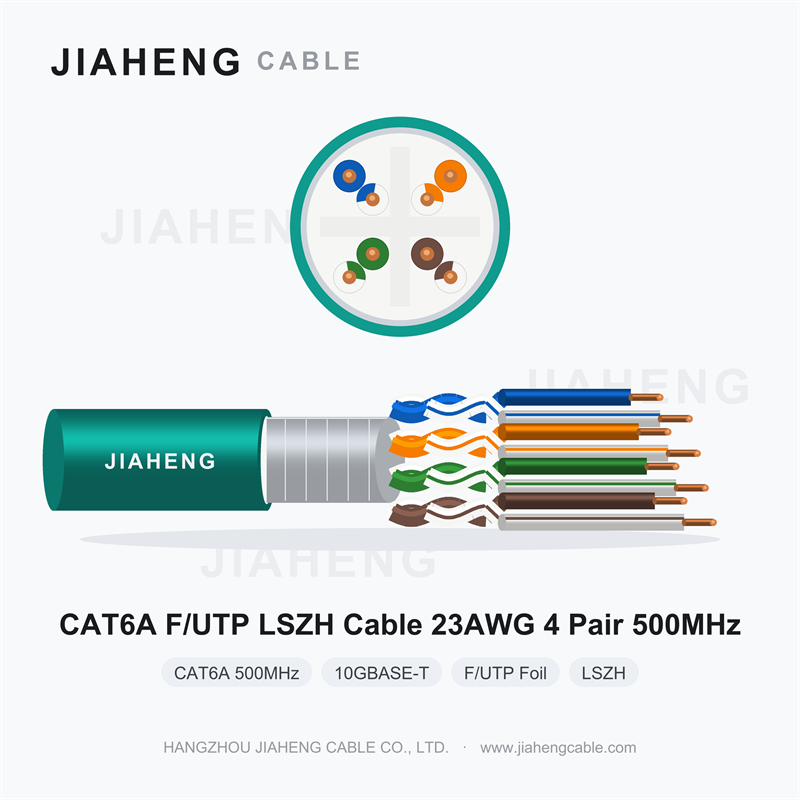
Confirmed Cable Specifications
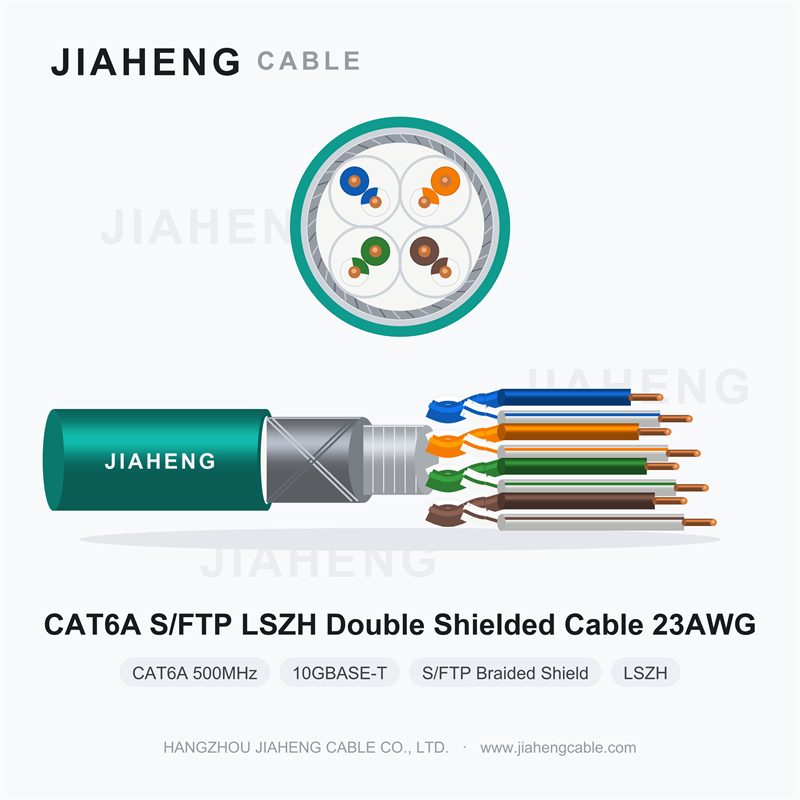
• Category: CAT6A (Class EA), bandwidth 500 MHz
• Ethernet application: 10GBASE-T 10-Gigabit Ethernet, 100 m channel
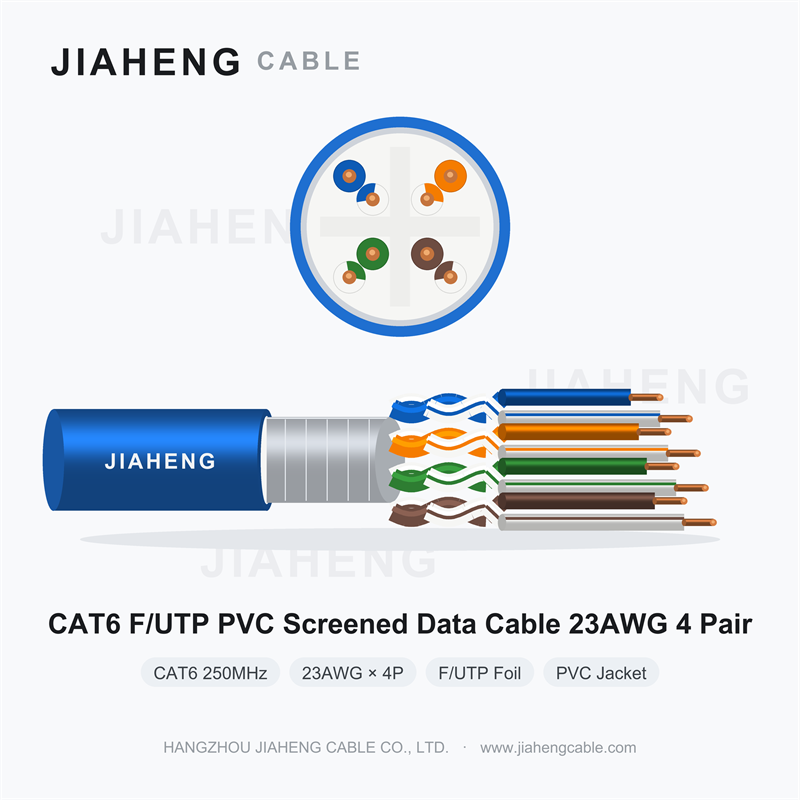
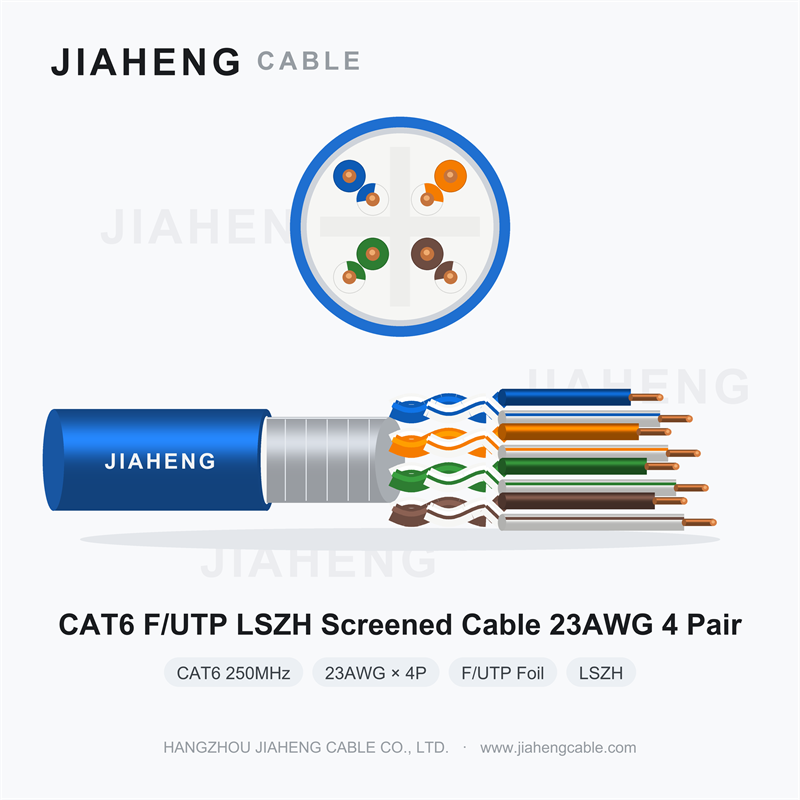
• Shielding: F/UTP (Overall aluminum foil shielding)
• Jacket: LSZH (Low Smoke Zero Halogen)
• Conductor size: 23AWG (approx. 0.57 mm diameter)
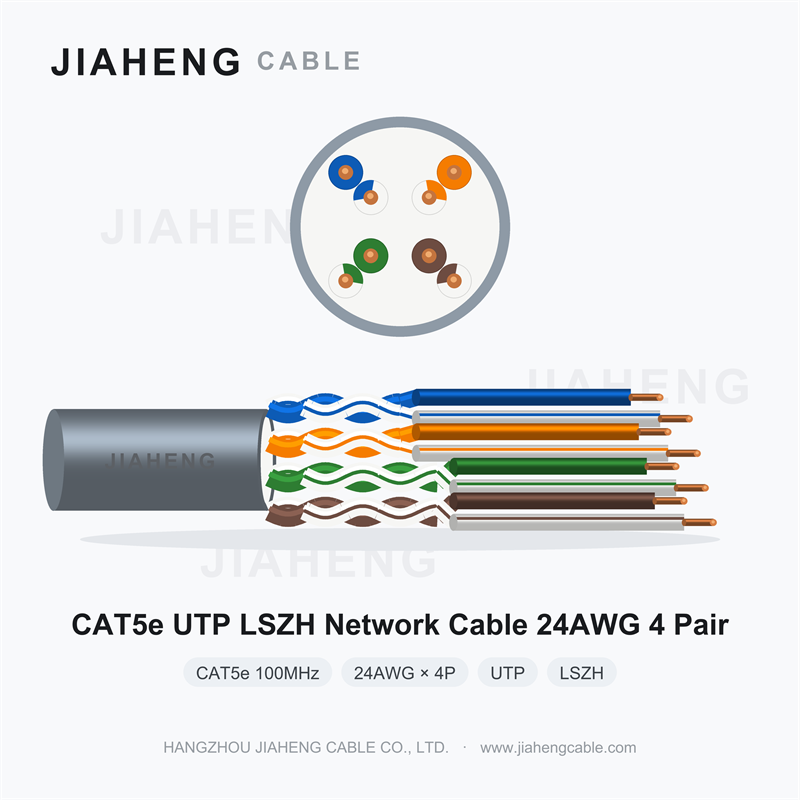
• Pairs: 4 pairs (8 cores)
1. Product Overview
CAT6A F/UTP LSZH 23AWG×4P is a 500 MHz four-pair data cable with an overall foil screen and LSZH jacket, engineered to deliver 10GBASE-T — 10 Gigabit Ethernet — across a full 100 metre channel. Where CAT6 reaches 250 MHz and CAT5e reaches 100 MHz, CAT6A doubles CAT6's bandwidth, and that doubling is not a marketing increment. It is what makes 10 Gigabit to the outlet over standard distances physically possible.
This is the cable to specify when 10 Gigabit is a requirement rather than a possibility.
2. The Real Difficulty at 10 Gigabit: Alien Crosstalk
Most people assume the obstacle to 10GBASE-T is bandwidth inside a single cable. It is not. The dominant impairment is alien crosstalk — interference coupling between different cables lying adjacent to one another in the same bundle, tray or conduit.
Why does this become decisive at 10GBASE-T? Because the application uses all four pairs in both directions simultaneously with dense pulse-amplitude modulation, and it operates at frequencies where a neighbouring cable's field couples efficiently into the pairs alongside it. At Gigabit speeds this coupling is largely irrelevant; at 10 Gigabit it can be the difference between a channel that certifies and one that does not.
Critically, alien crosstalk cannot be measured or compensated at the individual link level in the way internal crosstalk can. It depends on what is installed next to the cable, how tightly cables are bundled, and how long the parallel run is. This is why 10GBASE-T specifications treat it as a distinct parameter (ANEXT and AFEXT) and why cable construction matters so much.
3. How This Cable Addresses It Three features work together:
• The 500 MHz bandwidth provides the internal performance margin — lower insertion loss, controlled return loss and pair-to-pair crosstalk — needed before external effects are even considered.
• The overall foil screen is the primary defence against alien crosstalk. A continuous conductive enclosure around the pairs substantially attenuates field coupling between neighbouring screened cables, which is precisely the mechanism that creates ANEXT. This is a significant part of why screened CAT6A is so widely used in high-density 10 Gigabit installations.
• The internal geometry — conductor insulation, twist lay and any pair-separating structure — maintains the balance that all of the above depends on.
Request the alien crosstalk test documentation if the project has a large bundled installation. Not every supplier measures it, and for a 10 Gigabit project it is the parameter most likely to be the reason for failure.
4. Physical Size and Installation Planning
CAT6A is larger and stiffer than CAT6. The higher bandwidth demands thicker insulation and more controlled geometry, and the screen adds further diameter. This has consequences that should be planned before cable is ordered:
• Conduit and trunking fill ratios must be recalculated. A route sized for CAT6 may not accommodate CAT6A.
• Bend radius is larger. Tight turns around corners and inside cabinets that were fine for CAT6 can damage CAT6A or degrade its performance.
• Cable management in racks needs more space, and patch panels must be the shielded CAT6A type with adequate port spacing.
• Pulling tension limits are more important. Exceeding them during installation permanently degrades performance.
Plan the route, the containment sizes and the cabinet layout against the actual cable diameter, not against a generic assumption.
5. When CAT6A Is the Right Answer, and When It Is Not Specify CAT6A when:
• 10GBASE-T to work area outlets over full channel length is a defined requirement.
• The installation is a data centre, server room, or high-density environment where many cables run together and alien crosstalk risk is highest.
• The building has a long intended life and the owner wants to avoid a second re-cabling exercise.
• The network will carry high-wattage PoE (802.3bt Type 3/4) alongside 10 Gigabit data.
CAT6 may suffice when:
• Gigabit to the desk is the requirement and 10 Gigabit is confined to short backbone links between switches, where other media or short-reach configurations apply.
• Budget is a hard constraint and the occupancy density per outlet is low.
• The containment already installed cannot physically accommodate the larger cable.
6. Screened Construction: The Bonding Requirement Again
As with all screened products, the foil screen delivers its benefit only when properly terminated. Shielded CAT6A connectors, patch panels and outlets of matching category are mandatory — mixing shielded cable with unshielded hardware discards the alien crosstalk protection that was the reason for specifying it. Use wide-area bonding, confirm the drain wire is present, and follow the project's earthing scheme (single-ended for typical installations, double-ended with equipotential bonding where high-frequency performance requires it).
7. LSZH for Public and Regulated Premises
The LSZH jacket meets low-smoke, halogen-free requirements for enclosed and high-occupancy buildings — hospitals, airports, metros, universities, high-rise offices. In a data centre or public building this is frequently mandated regardless of cable category. Request IEC 60754 and IEC 61034 documentation for the supplied product.
8. Applications
• Data centres: top-of-rack and end-of-row connections, server and storage cabling
• Enterprise backbones and high-performance work area outlets
• Campuses, universities and research facilities with 10 Gigabit to the desk
• Healthcare imaging, broadcast and media workflows requiring sustained high throughput
• High-density PoE++ installations combining 10 Gigabit data with high-wattage power
• New builds designed for a long service life with upgrade headroom
9. Ordering Guidance
Confirm conductor material (oxygen-free bare copper is essential for a 10GBASE-T permanent link), overall diameter for containment planning, alien crosstalk test availability, box length, and that matching shielded CAT6A connectors and panels will be supplied. State the intended bundle configuration so the supplier can advise on installation spacing.
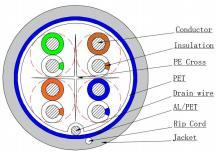
Technical parameter
| Type | CAT6A F/UTP 23AWG×4P |
| (mm) Specification | |
| Conductor | |
| Conductor material | BC |
| Conductor size | 23AWG×4P |
| ConductorConstruction(mm) | 0.55±0.01 |
| Insulation | |
| Insulation material | PE |
| Insulation diameter (mm) | 1.08±0.05 |
| Average Thickness (mm) | 0.25 |
| Min Thickness (mm) | 0.2 |
| Color | Blue, White-Blue, Orange, White-Orange, Green, White-Green, Brown, White-Brown |
| Fill | |
| Fill material | FR-PE Cross |
| Wrapping tape | |
| Wrapping tape material | PET |
| Drain wire | |
| Drain wire material | TC |
| Drain wire size(mm) | 0.4±0.01 |
| Shield | |
| Shield material | AL/PET |
| Rip-cord | |
| Rip-cord | Yes |
Detailed technical parameters
| Type | CAT6A F/UTP 23AWG×4P | ||||||
| (mm)Specification | |||||||
| Jacket | |||||||
| Jacket material | LSZH | ||||||
| Jacket diameter (mm) | 7.2±0.4 | ||||||
| Average Thickness (mm) | 0.6 | ||||||
| Min Thickness (mm) | 0.5 | ||||||
| Color | According to customer’s requirement | ||||||
| Electrical&PHsical Characteristic: | |||||||
| Conductor DCR 20℃ | ≤93.8 Ω/km | ||||||
| Characteristic Impedance(Ohm) | 100±15 | ||||||
| Operational Temperature | -20℃~+90℃ | ||||||
| Channel transmission performance(100M) | |||||||
|
Frequency (MHz) |
Attenuation (dB) |
NEXT (dB) |
PSNEXT (dB) |
ACRF (dB) |
PSACRF (dB) |
Return loss (dB) |
Delay (ns) |
| 4 | 4.2 | 63 | 60.5 | 51.2 | 48.2 | 19 | 562 |
| 8 | 5.8 | 58.2 | 55.6 | 45.2 | 42.2 | 19 | 557 |
| 10 | 6.5 | 56.6 | 54 | 43.3 | 40.3 | 19 | 555 |
| 16 | 8.2 | 53.2 | 50.6 | 39.2 | 36.2 | 18 | 553 |
| 20 | 9.2 | 51.6 | 49 | 37.2 | 34.2 | 17.5 | 552 |
| 25 | 10.2 | 50 | 47.3 | 35.3 | 32.3 | 17 | 551 |
| 31.25 | 11.5 | 48.4 | 45.7 | 33.4 | 30.4 | 16.5 | 550 |
| 62.5 | 16.4 | 43.4 | 40.6 | 27.3 | 24.3 | 14 | 549 |
| 100 | 20.9 | 39.9 | 37.1 | 23.3 | 20.3 | 12 | 548 |
| 200 | 30.1 | 34.8 | 31.9 | 17.2 | 14.2 | 9 | 547 |
| 250 | 33.9 | 33.1 | 30.2 | 15.3 | 12.3 | 8 | 546 |
| 300 | 37.4 | 31.7 | 28.8 | 13.7 | 10.7 | 7.2 | 546 |

 sales@jiahengcable.com
 +86-19357267601

 Heziwu, Shuangyuan Village, Linglong Subdistrict, Lin'an District, Hangzhou City, Zhejiang Province, P.R.China
Copyright © Hangzhou Linan Jiaheng Cable Co., Ltd. All Rights Reserved
