

 English
 Ethernet Cable
Home / Products / Ethernet Cable / CAT5e UTP LSZH Network Cable 24AWG 4 Pair for Gigabit Ethernet Building Cabling

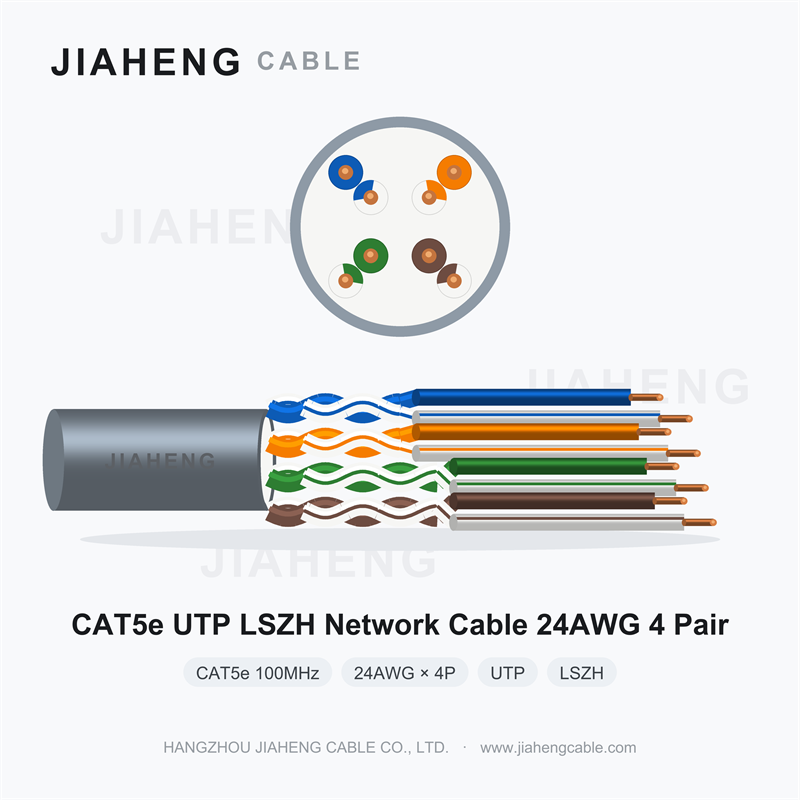
Confirmed Cable Specifications
• Category: CAT5e (Class D), bandwidth 100 MHz
• Ethernet application: 1000BASE-T Gigabit Ethernet (100 m channel)
• Shielding: UTP — Unshielded Twisted Pair
• Jacket: LSZH (Low Smoke Zero Halogen)
• Conductor size: 24AWG (approx. 0.51 mm diameter)
• Pairs: 4 pairs (8 cores)
1. Product Overview
CAT5e UTP LSZH 24AWG×4P is a four-pair unshielded twisted-pair data cable operating at 100 MHz, finished with a Low Smoke Zero Halogen jacket. It supports 1000BASE-T Gigabit Ethernet across a full 100 metre channel, which is the specification that governs the overwhelming majority of horizontal cabling installed in commercial buildings today.
Two decisions define this product. First, UTP construction: with no metallic screening, the cable relies entirely on the balance produced by each pair's precise twist lay to reject interference. That makes it lighter, more flexible, cheaper to terminate and far faster to install than screened alternatives — and in a typical office environment, where the nearest strong interference source is a lighting circuit or a power socket, that balance is sufficient. Second, LSZH jacketing: the material choice is not about data performance at all, but about what happens to the building's occupants if a fire starts.
2. Why CAT5e Remains the Volume Leader
CAT6 and CAT6A are technically superior, and for new builds with a long horizon they are often the right call. CAT5e nonetheless continues to sell in very large quantities for three practical reasons. Its 100 MHz bandwidth already carries Gigabit Ethernet to 100 m, and for most tenants Gigabit to the desk remains entirely adequate. Its smaller diameter and greater flexibility make it easier to pull through congested conduit and to dress neatly in patch panels. And its lower cost per metre means a budget that has to cover many outlets goes further.
Where CAT5e is genuinely the wrong choice is a project with a defined near-term migration to 10GBASE-T, or a PoE-heavy installation running high-wattage Type 3 or Type 4 power over long distances — in those cases the larger conductor of CAT6 or CAT6A reduces resistive heating and voltage drop.
3. The 24AWG Conductor Question
24AWG solid copper is the standard conductor for a permanent link at this category. Compared with the 23AWG used in most CAT6 constructions, 24AWG has slightly higher DC resistance per metre. For pure data transmission at 100 MHz over normal channel lengths this difference has no practical effect on Gigabit performance. It becomes relevant when the same cable carries PoE, because conductor resistance determines both voltage drop to the powered device and resistive heating inside the cable bundle.
For 802.3af and 802.3at loads (roughly up to 30 W at the sourcing equipment) on typical run lengths, 24AWG is a workable and widely deployed choice. For 802.3bt Type 3 or Type 4 loads, or where many PoE cables are bundled together with limited heat dissipation, specify 23AWG or larger and derate the bundle according to the applicable installation guidance.
4. LSZH: The Reason This Cable Gets Specified
In a fire, a PVC-jacketed cable releases hydrogen chloride, which forms hydrochloric acid on contact with moisture in the respiratory tract and on electronic equipment, and produces dense black smoke that obscures escape routes. LSZH compounds substitute halogen-free, low-smoke-emitting materials, so the gases released are far less corrosive and visibility is maintained longer. That is the difference between occupants being able to find an exit and not being able to.
Regulators have responded by mandating low-smoke, halogen-free materials in enclosed and high-occupancy spaces — underground stations, airport terminals, hospitals, schools, cinemas, high-rise escape routes and tunnels. Specifying LSZH is therefore frequently not a preference but a compliance requirement. The relevant performance is normally demonstrated against IEC 60754 for halogen content and acid gas generation and IEC 61034 for smoke density; request the applicable test report for the exact cable being supplied rather than relying on a generic material certificate.
5. Applications
• Horizontal cabling from floor distributors to work area outlets in offices and commercial buildings
• Structured cabling in schools, universities, hospitals and public buildings where LSZH is mandated
• Telephone and VoIP handsets, IP cameras at standard PoE levels, wireless access points
• Light industrial and warehouse office areas without significant electromagnetic interference
• Residential and multi-dwelling unit data and voice distribution
• Retrofit projects replacing older CAT3 or CAT5 installations
6. Installation and Termination Notes
Because the cable is unshielded, its interference rejection depends on preserving pair balance. Keep twist lay as close to the termination point as the connector allows, maintain the manufacturer's minimum bend radius, and do not over-tighten cable ties — crushing the cable distorts pair geometry and degrades performance. Route data cable separated from power conductors rather than running long parallel lengths in the same tray, and observe the applicable separation distances.
Terminate consistently to one colour code, T568A or T568B, throughout the whole project. Mixing codes between the two ends of a link produces a crossover that will not pass certification.
7. Ordering Guidance
The single most consequential specification item is conductor material. Oxygen-free bare copper is the correct choice for any permanent link. Copper-clad aluminium and copper-clad steel are offered at materially lower prices, but their higher resistance degrades PoE performance and their brittleness leads to failures at terminations; they should never be substituted into a permanent link without the buyer's explicit agreement. Confirm conductor material, box length, printing requirements and whether LSZH test reports are supplied with the shipment before placing an order.
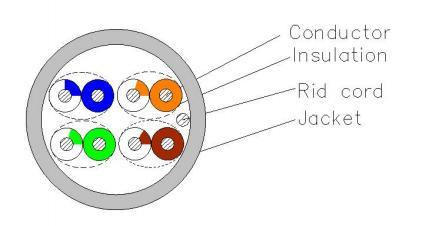
Technical parameter
| Type | CAT5e UTP 24AWG×4P |
| (mm) Specification | |
| Conductor | |
| Conductor material | BC |
| Conductor size | 24AWG ×4P |
| Conductor Construction (mm) | 0.485±0.01 |
| Insulation | |
| Insulation material | PE |
| Insulation diameter (mm) | 0.85±0.05 |
| Average Thickness (mm) | 0.18 |
| Min Thickness (mm) | 0.15 |
| Color | Blue, White, Orange, White, Green, White, Brown, White |
| Rip-cord | |
| Rip-cord | Yes |
| Jacket | |
| Jacket material | LSZH |
| Jacket Diameter(mm) | 4.8±0.2 |
| Average Thickness(mm) | 0.5 |
| Min Thickness(mm) | 0.45 |
| Color | According to the customer’s requirement |
Detailed technical parameters
| Type | CAT6 UTP 23AWG×4P | ||||||
| (mm)Specification | |||||||
| Electrical&PHsical Characteristic: | |||||||
| Conductor DCR 20℃ | ≤93.8 Ω/km | ||||||
| Characteristic Impedance(Ohm) | 100±15 | ||||||
| Operational Temperature | -20℃~+70℃ | ||||||
| Channel transmission performance(100M) | |||||||
|
Frequency (MHz) |
Attenuation (dB) |
NEXT (dB) |
PSNEXT (dB) |
ACRF (dB) |
PSACRF (dB) |
Return loss (dB) |
Delay (ns) |
| 1 | 2.2 | 60 | 57 | 57.4 | 54.4 | 17 | 580 |
| 4 | 4.5 | 53.5 | 50.5 | 45.4 | 42.4 | 17 | 562 |
| 8 | 6.3 | 48.6 | 45.6 | 39.3 | 36.3 | 17 | 557 |
| 10 | 7.1 | 47 | 44 | 37.4 | 34.4 | 17 | 555 |
| 16 | 9.1 | 43.6 | 40.6 | 33.3 | 30.3 | 17 | 553 |
| 20 | 10.2 | 42 | 39 | 31.4 | 28.4 | 17 | 552 |
| 25 | 11.4 | 40.3 | 37.3 | 29.8 | 26.4 | 16 | 551 |
| 31.25 | 12.9 | 38.7 | 35.7 | 27.5 | 24.5 | 15.1 | 550 |
| 62.5 | 18.6 | 33.6 | 30.6 | 21.5 | 18.5 | 12.1 | 549 |
| 100 | 24 | 30.1 | 27.1 | 17.4 | 14.4 | 10 | 548 |

 sales@jiahengcable.com
 +86-19357267601

 Heziwu, Shuangyuan Village, Linglong Subdistrict, Lin'an District, Hangzhou City, Zhejiang Province, P.R.China
Copyright © Hangzhou Linan Jiaheng Cable Co., Ltd. All Rights Reserved
