

 English
 Ethernet Cable
Home / Products / Ethernet Cable / CAT6 F/UTP PVC Screened Data Cable 23AWG 4 Pair for Industrial and Plant Room Cabling

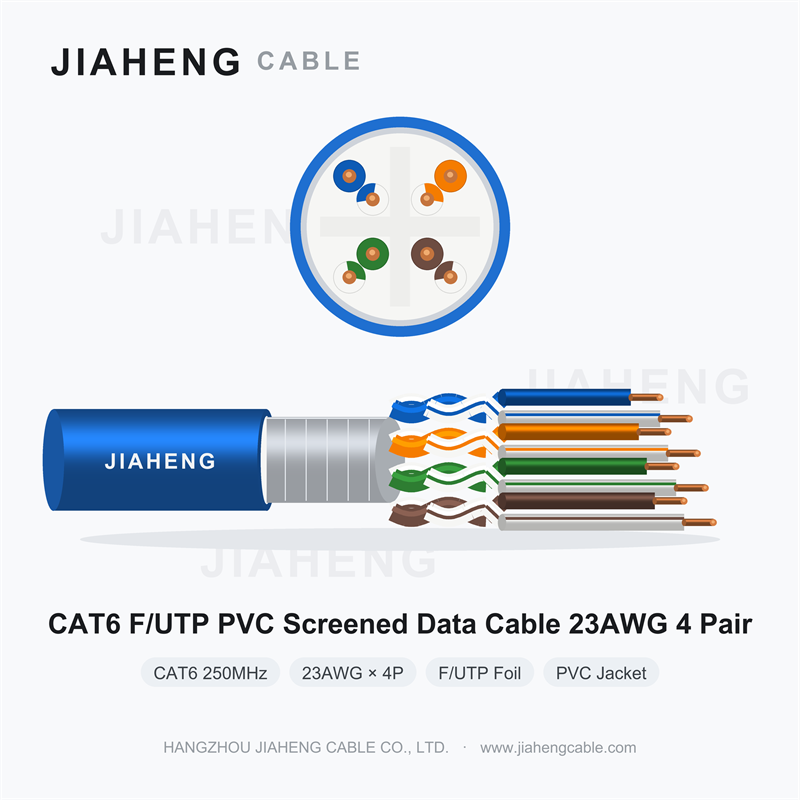
Confirmed Cable Specifications
• Category: CAT6 (Class E), bandwidth 250 MHz
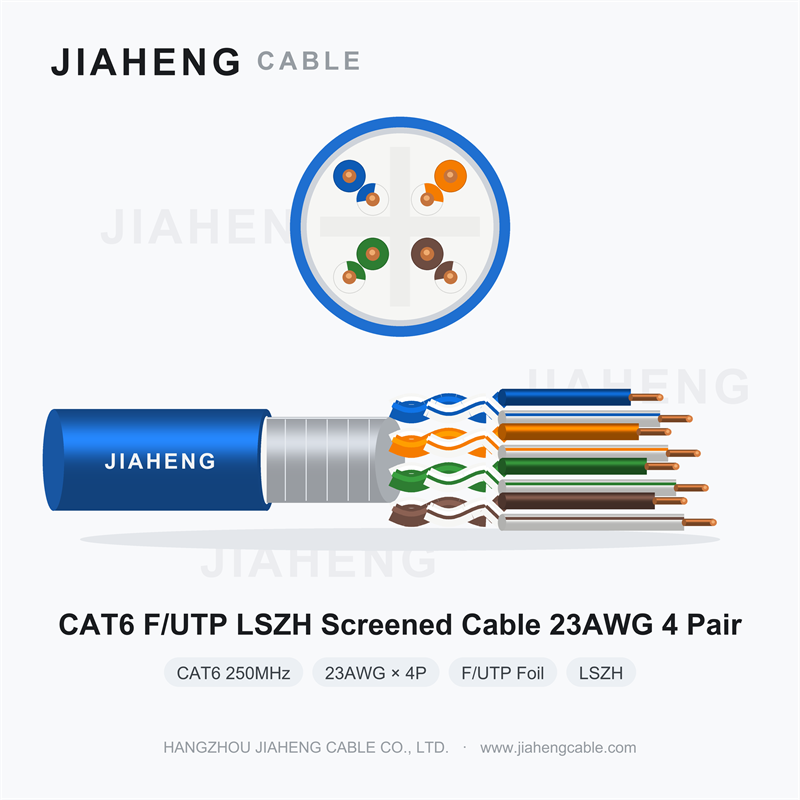
• Shielding: F/UTP (Overall aluminum foil shielding)
• Jacket: PVC (Non-LSZH)
• Conductor size: 23AWG (approx. 0.57 mm diameter)
• Pairs: 4 pairs (8 cores)
1. Product Overview
CAT6 F/UTP PVC 23AWG×4P pairs a 250 MHz four-pair construction with an overall aluminium foil screen and a PVC jacket. It is electrically identical in intent to the LSZH-jacketed screened version, and differs in one respect only: the outer material. That single difference determines where this cable belongs and where it must not go.
Treating jacket material as a minor line item is a common specification error. It is not minor. It decides whether the cable is legal in the building you are installing it in, and it changes the price meaningfully.
2. What PVC Does Well
Polyvinyl chloride has been the default data cable jacket for decades because it performs well on the properties that matter in most non-public installations:
• Mechanical durability. PVC resists abrasion during pulls through conduit and tray, tolerates compression from cable ties and stacking, and holds up under foot traffic in accessible floor areas.
• Chemical and oil resistance. Standard PVC compounds withstand the oils, coolants and cleaning agents found in plant rooms, workshops and light industrial areas — a genuine advantage over many halogen-free compounds, which can be more susceptible to certain chemicals.
• Cost. PVC is materially cheaper per metre than LSZH. On a large project with many hundreds of outlets, that difference is real money.
• Flame retardancy in its own right. PVC is inherently flame retardant because of its chlorine content and self-extinguishes once the ignition source is removed. It meets single-flame and, in appropriate compounds, bundled-flame test requirements.
3. What PVC Does Not Do
When PVC burns it releases hydrogen chloride. That gas combines with moisture — in the air, in lungs, on circuit boards — to form hydrochloric acid. It also generates dense, opaque smoke.
The consequences are what drive regulation: reduced visibility during evacuation, respiratory injury to occupants and firefighters, and corrosive damage to electronic equipment that survives the fire itself. For this reason low-smoke halogen-free materials are required in enclosed and high-occupancy locations.
4. The Boundary Line: Where Each Jacket Belongs
Specify this PVC-jacketed cable where:
• The installation is in a plant room, machinery space, workshop, warehouse, basement service area or equipment enclosure that is not a public or occupied space.
• The building's applicable code does not mandate halogen-free materials in that location.
• Oil, coolant or chemical exposure makes a robust jacket the priority.
• Budget is constrained and the location genuinely does not carry public-occupancy risk.
Specify the LSZH version instead where:
• The space is a public area, escape route, hospital, school, university, airport, metro, cinema, high-rise occupied floor or any enclosed location with significant occupant density.
• The project specification, national code or insurer requires low-smoke halogen-free cabling.
• Cable is concealed above ceilings or below raised floors serving occupied spaces — concealment does not remove the requirement.
Getting this wrong in either direction is costly. LSZH in a location that does not need it wastes budget; PVC in a location that requires LSZH can fail inspection, force a complete re-pull, and — far worse — compromise life safety.
5. Why Screened Here
Screened construction is common on PVC-jacketed cable for a logical reason: the environments where PVC is appropriate (plant rooms, industrial areas, machinery spaces) are also environments with variable speed drives, motor feeders, contactors and switching equipment. The foil screen addresses the external interference those sources generate.
As with all screened cable, the screen requires correct bonding through shielded connectors, patch panels and outlets of matching category, using wide-area contact and the appropriate single- or double-ended earthing practice. Confirm a drain wire is present so field termination is practical.
6. Applications
• Industrial plant networks and machine-level cabling in manufacturing areas
• Equipment rooms, plant rooms, riser cupboards and basement service spaces
• Warehouses, logistics facilities and cold-chain areas (confirm low-temperature compound if relevant)
• Workshops and technical areas with oil or coolant exposure
• Security and CCTV installations in non-public parts of commercial or industrial sites
• Cabinet and enclosure internal cabling where PVC durability is an advantage
7. Ordering Guidance
Confirm conductor material, foil construction, drain wire presence, and — importantly for this product — the PVC compound type if the cable will encounter oil, solvents, ultraviolet exposure or low temperatures. State box length and printing. Before ordering, verify against the project specification that PVC is permitted in the intended location; if the location is uncertain, ordering the LSZH version removes the risk.
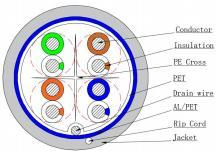
Technical parameter
| Type | CAT6 F/UTP 23AWG×4P |
| (mm) Specification | |
| Conductor | |
| Conductor material | BC |
| Conductor size | 23AWG×4P |
| ConductorConstruction(mm) | 0.573±0.01 |
| Insulation | |
| Insulation material | PE |
| Insulation diameter (mm) | 1.02±0.05 |
| Average Thickness (mm) | 0.2 |
| Min Thickness (mm) | 0.18 |
| Color | Blue, White-Blue, Orange, White-Orange, Green, White-Green, Brown, White-Brown |
| Fill | |
| Fill material | FR-PE Cross |
| Wrapping tape | |
| Wrapping tape material | PET |
| Drain wire | |
| Drain wire material | TC |
| Drain wire size(mm) | 1/0.4±0.005 |
| Shield | |
| Shield material | AL/PET |
| Rip-cord | |
| Rip-cord | Yes |
Detailed technical parameters
| Jacket | |||||||
| Jacket material | PVC | ||||||
| Jacket diameter (mm) | 5.65±0.2 | ||||||
| Average Thickness (mm) | 1.04 | ||||||
| Min Thickness (mm) | 0.99 | ||||||
| Color | According to customer’s requirement | ||||||
| Electrical&PHsical Characteristic: | |||||||
| Conductor DCR 20℃ | ≤93.8 Ω/km | ||||||
| Characteristic Impedance(Ohm) | 100±15 | ||||||
| Operational Temperature | -20℃~+75℃ | ||||||
| Channel transmission performance(100M) | |||||||
|
Frequency (MHz) |
Attenuation (dB) |
NEXT (dB) |
PSNEXT (dB) |
ACRF (dB) |
PSACRF (dB) |
Return loss (dB) |
Delay (ns) |
| 1 | 2.1 | 65 | 62 | 63.3 | 60.3 | 20 | 580 |
| 4 | 4 | 63 | 60.5 | 51.2 | 48.2 | 20 | 562 |
| 8 | 5.7 | 58.2 | 55.6 | 45.2 | 42.2 | 20 | 557 |
| 10 | 6.3 | 56.6 | 54 | 43.3 | 40.3 | 20 | 555 |
| 16 | 8 | 53.2 | 50.6 | 39.2 | 36.2 | 18.6 | 553 |
| 20 | 9 | 51.6 | 49 | 37.2 | 34.2 | 17.9 | 552 |
| 25 | 10.1 | 50 | 47.3 | 35.3 | 32.3 | 17.2 | 551 |
| 31.25 | 11.4 | 48.4 | 45.7 | 33.4 | 30.4 | 16.5 | 550 |
| 62.5 | 16.5 | 43.4 | 40.6 | 27.3 | 24.3 | 14.4 | 549 |
| 100 | 21.3 | 39.9 | 37.1 | 23.3 | 20.3 | 13 | 548 |
| 200 | 31.5 | 34.8 | 31.9 | 17.2 | 14.2 | 10.9 | 547 |
| 250 | 35.9 | 33.1 | 30.2 | 15.3 | 12.3 | 10.2 | 546 |

 sales@jiahengcable.com
 +86-19357267601

 Heziwu, Shuangyuan Village, Linglong Subdistrict, Lin'an District, Hangzhou City, Zhejiang Province, P.R.China
Copyright © Hangzhou Linan Jiaheng Cable Co., Ltd. All Rights Reserved
