

 English
Industry News
Home / News / Industry News / Integrated Power Wires: 18AWG Voltage Drop in Composite Cables for PTZ Dome Cameras

Content
A pan-tilt-zoom dome camera is not a steady load. The motors draw a burst when the head starts to move, the IR illuminator switches on at dusk, the heater cycles in cold weather, and the zoom lens adds its own demand. Every one of those amps has to travel from the power supply to the housing along the same pair of conductors, and when that pair is an 18AWG wire inside a composite cable, the voltage that finally reaches the camera is always lower than the voltage that left the supply.
That difference is the voltage drop, and it is the most common reason a PTZ dome reboots mid-preset, loses video during a pan, or fails in its second winter after a clean first year. The numbers below show how much drop 18AWG power cores actually produce at realistic PTZ loads, how the picture changes between 12V DC and 24V AC, and where the practical distance limits sit for an integrated composite camera cable.
A composite cable, often called a Siamese cable in CCTV work, carries two functions in one jacket: a video or data member and a two-core power pair. In the classic analog configuration the signal member is a 20AWG bare copper coax, while the power member is two 18AWG copper conductors rated for the camera supply.
The construction saves a second pull, holds the power and signal members at a fixed spacing, and guarantees that both halves share the same jacket compound and the same routing environment. It also fixes the conductor size long before the installer sees the site, which is exactly why the 18AWG figure deserves attention at the design stage rather than after termination.
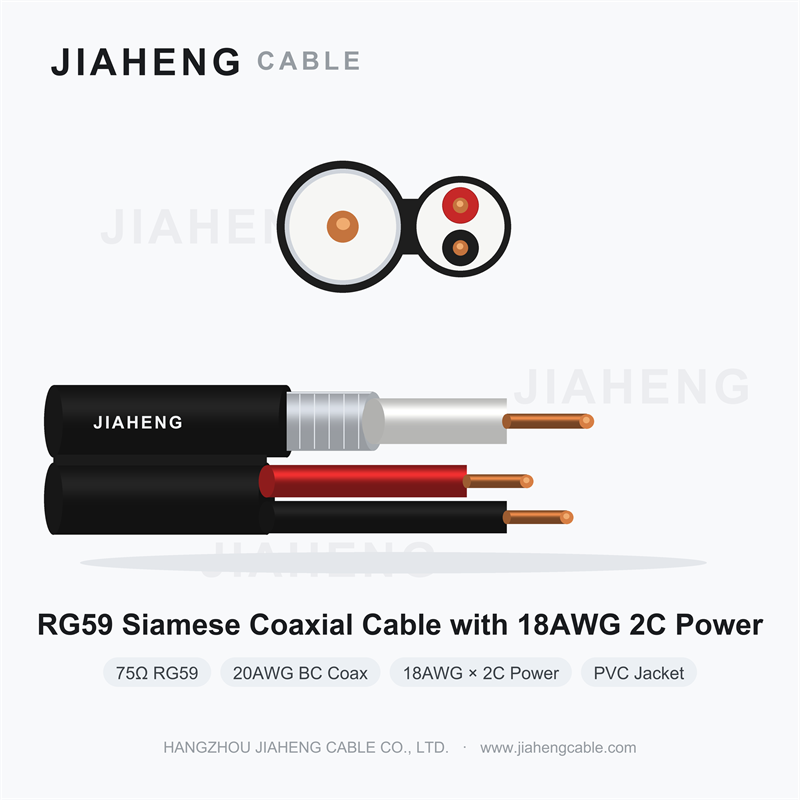 RG59 Siamese Cable with 18AWG 2C PowerCombines 75-ohm RG59 video and 18AWG two-core power in one parallel-bonded jacket, simplifying CCTV routing while keeping conductor sizing fixed for long runs.View Product →
For a closer look at how jacket material, shield type and conductor class interact over long camera runs, the guide to choosing the right composite CCTV cable for long distance covers the selection side in more depth.
Voltage drop is Ohm's law applied to the complete circuit, which means the current travels down one conductor and returns along the other. The return path therefore counts as fully as the outgoing path, and the formula carries a factor of two.
Vd = 2 x I x R x L
Vd is the voltage drop in volts; I is the load current in amps; R is the conductor resistance in ohms per 1000 ft or per km; L is the one-way length in thousands of ft or in km.
| Conductor | Resistance per 1000 ft | Resistance per km | Typical role in camera cabling |
|---|---|---|---|
| 20AWG | 10.2 ohm | 33 ohm | Short power tails and jumpers |
| 18AWG | 6.4 ohm | 21 ohm | Standard Siamese power pair |
| 16AWG | 4.0 ohm | 13 ohm | Longer 12V DC runs |
| 14AWG | 2.5 ohm | 8.2 ohm | Heavy loads and heater circuits |
A 12V DC camera that accepts a supply tolerance of plus or minus 10 percent has roughly 1.2V of total budget, and connectors, splices, fuses and the supply's own regulation all consume part of it. Holding cable drop at or below 5 percent of the supply voltage leaves room for everything else; 10 percent is the outer limit, not the design target.
Take a 12V DC PTZ dome drawing 1.0A, fed through the 18AWG pair of a composite cable. Resistance is about 6.4 ohm per 1000 ft per conductor, so the round-trip resistance in ohms equals 2 x 6.4 x L, with L expressed in thousands of ft.
| One-way length | Round-trip resistance | Drop at 1.0A | Share of a 12V supply |
|---|---|---|---|
| 50 ft (15 m) | 0.64 ohm | 0.64 V | 5.3 percent |
| 100 ft (30 m) | 1.28 ohm | 1.28 V | 10.7 percent |
| 150 ft (46 m) | 1.92 ohm | 1.92 V | 16.0 percent |
| 200 ft (61 m) | 2.56 ohm | 2.56 V | 21.3 percent |
The table makes the limit obvious. At 1.0A an 18AWG pair stays inside the 5 percent target at roughly 50 ft and reaches the 10 percent ceiling close to 90 ft. Halve the current to 0.5A and both distances double; double it for a heater cycle and they halve again. This is why two sites with identical cable and identical cameras can behave completely differently: one runs a 0.4A fixed load, the other a 1.5A PTZ with a heater.
The cable does not change and the current does not change, but the percentage drop does. The same absolute volt loss is a far smaller fraction of a 24V supply than of a 12V supply, so the acceptable distance roughly doubles before the tolerance is exhausted.
| One-way length | Drop at 1.0A | Share of a 24V supply |
|---|---|---|
| 100 ft (30 m) | 1.28 V | 5.3 percent |
| 200 ft (61 m) | 2.56 V | 10.7 percent |
| 300 ft (91 m) | 3.84 V | 16.0 percent |
| 400 ft (122 m) | 5.12 V | 21.3 percent |
Most 24V AC domes rectify and regulate internally, and many tolerate a wider input window than their 12V DC equivalents. That does not make the cable loss disappear, it simply moves the failure point farther out. A 24V AC dome pulling 1.0A through 18AWG power sits around 200 ft from the transformer before it consumes its full 10 percent allowance.
Every voltage drop calculation is only as good as the current value placed in it. Dome datasheets usually quote one power consumption figure, but the number that governs cable sizing is the worst-case simultaneous load.
Use the sum of the highest simultaneous figures, never the average. A dome that idles at 0.4A may pull 2.5A for a few seconds when the heater and the motors run together, and that is the exact moment when the supply at the camera sags and the unit resets.
A gauge comparison at a fixed load shows how quickly a larger conductor pays for itself. The figures below assume 12V DC, 1.0A and a 100 ft one-way run.
| Gauge | Round-trip resistance | Voltage drop | Share of 12V |
|---|---|---|---|
| 20AWG | 2.03 ohm | 2.03 V | 16.9 percent |
| 18AWG | 1.28 ohm | 1.28 V | 10.7 percent |
| 16AWG | 0.80 ohm | 0.80 V | 6.7 percent |
| 14AWG | 0.51 ohm | 0.51 V | 4.2 percent |
Where the composite cable cannot be replaced, the practical alternatives are to move the supply into a mid-span cabinet or the camera enclosure, to run a dedicated heavier power cable beside a data-only composite, or to feed the housing locally from the mains. For short drops from a cabinet to a single housing, a flexible control and power construction handles the current with negligible loss, and shielded variants suit installations where the supply shares a tray with signal cabling.
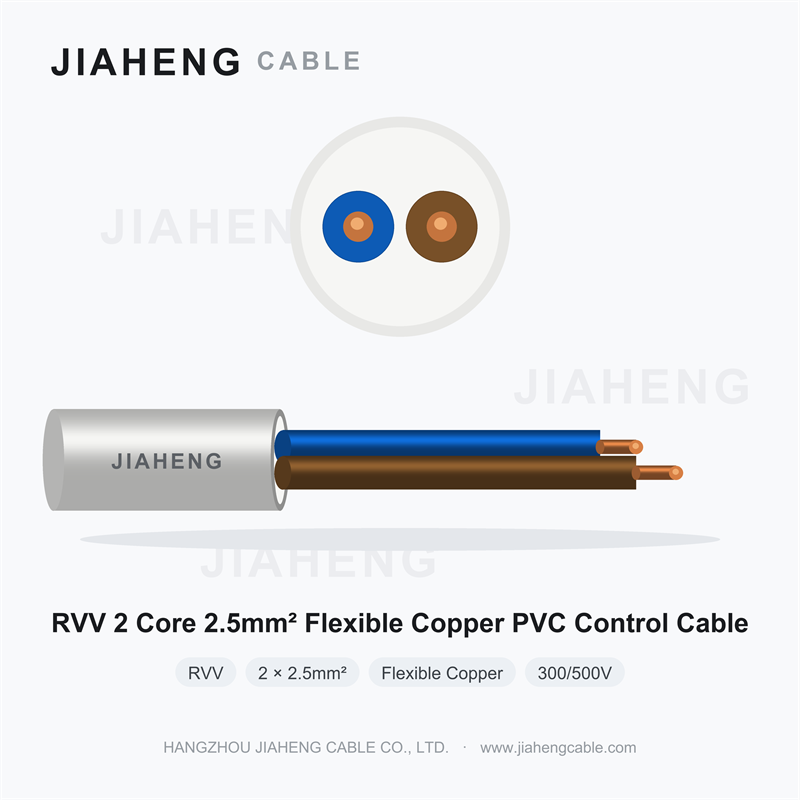 RVV 2-Core 2.5mm² Flexible Copper Control Power CableFor short cabinet-to-housing power drops, this flexible two-core 2.5mm² copper PVC cable suits hard-wired control and power connections and bends readily inside enclosures.View Product →
At a 1.0A load, roughly 50 ft keeps the drop inside 5 percent and about 90 ft reaches the 10 percent limit. At 0.5A those distances about double, and at 2A they halve. Always calculate with the worst-case current rather than the idle figure.
Close to it, at the same current. The permissible volt drop scales with supply voltage, so a 24V system absorbs about twice the cable loss of a 12V system before the same percentage limit is reached.
The motors and the heater pull a surge that the 18AWG pair cannot deliver without a large drop. The input at the camera falls below its minimum, the internal supply drops out and the unit restarts. Check loop resistance and supply headroom first.
Not as a design method. Paralleling conductors inside a composite cable is generally not accepted practice, it defeats the redundancy of the pair, and it complicates fault finding. Moving up one gauge is the cleaner answer.
For analog PTZ work it often is. Video tolerates a slightly smaller coax over medium distances far better than the camera tolerates a sagging supply, so a construction with 18AWG power and a standard coax is usually better balanced than a large coax paired with a thin power leg.
Voltage drop is arithmetic, not opinion. Once the worst-case current and the one-way length are known, the 18AWG power pair inside a composite cable either has margin or it does not. Designing to 5 percent instead of 10 percent costs nothing at the drawing stage and removes the most common field failure in PTZ dome installations.
For project-specific composite cable constructions, jacket materials and conductor combinations, the technical team can be reached through the contact page.

 sales@jiahengcable.com
 +86-19357267601

 Heziwu, Shuangyuan Village, Linglong Subdistrict, Lin'an District, Hangzhou City, Zhejiang Province, P.R.China
Copyright © Hangzhou Linan Jiaheng Cable Co., Ltd. All Rights Reserved Custom Industrial Wire and Cables Suppliers
