

 English

Product Category
Contact Us
Custom Industrial Instrumentation Cable Manufacturers
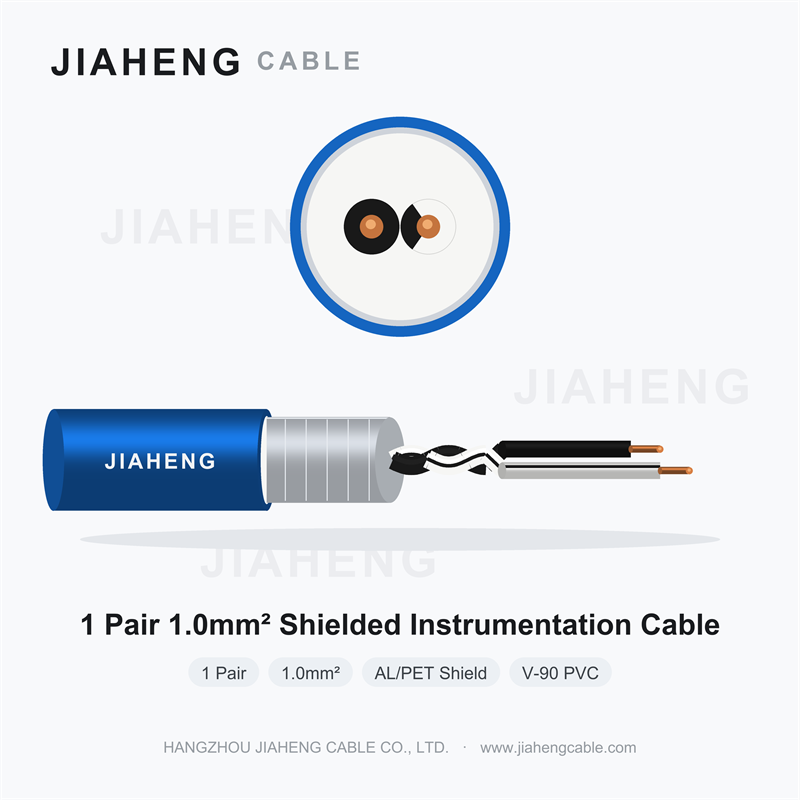
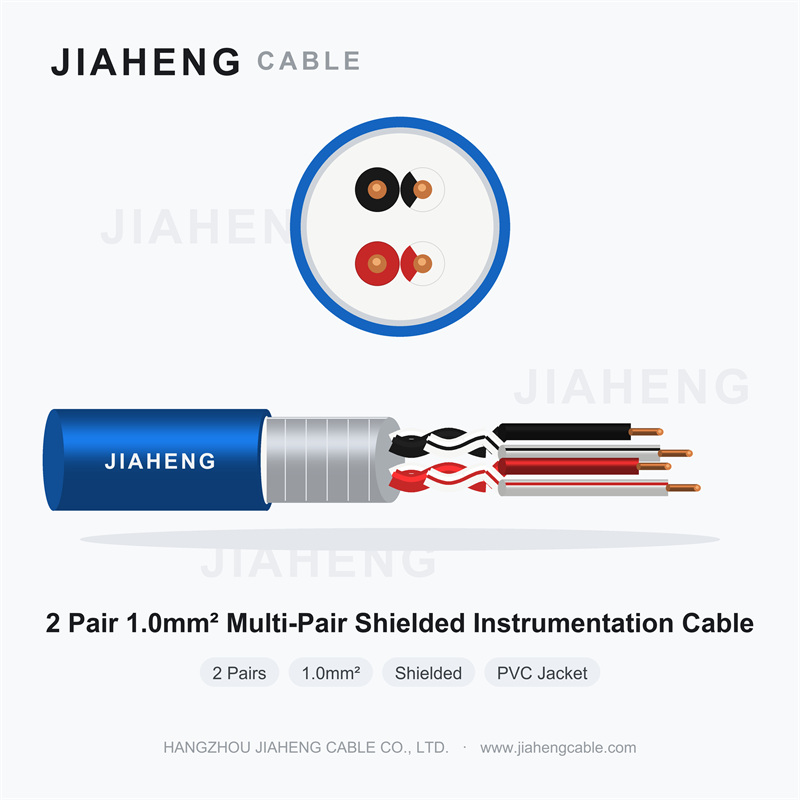
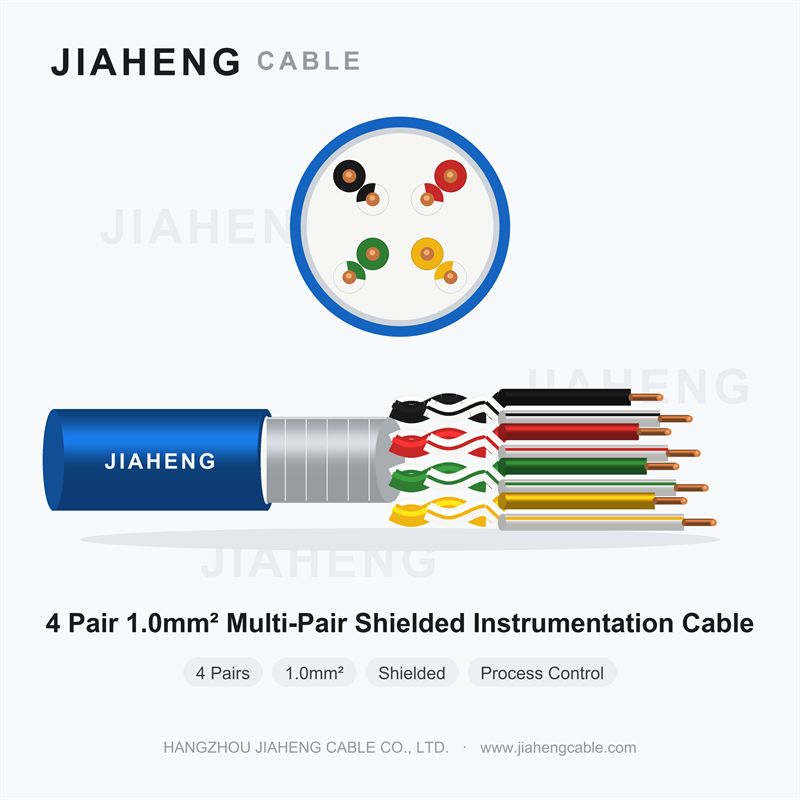
Instrumentation cable is designed for low-level signal transmission in industrial automation and process control loops, connecting transmitters, sensors, actuators, flow meters, analyzers, DCS and PLC equipment.
Unlike power cables, instrumentation cables carry 4-20 mA analog signals, thermocouple and RTD millivolt signals, RS-485 communication data and discrete switching signals. Because these signals are low in amplitude and highly susceptible to interference, the shielding structure, pair twist lay and insulation consistency are held to tighter tolerances. This product range uses AL/PET foil overall screening, optionally combined with copper braid or individual pair screening, to suppress EMI and RFI and preserve signal integrity and measurement accuracy over long cable runs.
Available from 1 pair to 24 pairs with conductor sizes from 0.5 mm² to 2.5 mm², and with V-90 PVC, LSZH or flame-retardant jackets, plus optional steel wire armour for project-specific requirements. Typical applications include petrochemical plants, power generation, metallurgy, water treatment, pharmaceuticals, food processing and building automation.
Who We Are
We Not Only Produce Network Cables. We Make Our Partnership Lasting.
Jiaheng Cable Co., Ltd. is China Custom Process Instrumentation Cable Manufacturers and Industrial Instrumentation Cable Suppliers , founded on January 23, 2008, with its headquarters located at Heziwu, Linglong Sub‑district, Lin’an District, Hangzhou, Zhejiang Province. With years of in‑depth experience in the cable industry, the company strives to be a global expert in high‑end network cables and digital connection solutions. We offer Instrumentation Cable for sale. Upholding the development philosophy of **Precise Connection & Intelligent Manufacturing**, Jiaheng has completed industrial upgrading and transformation. Evolving from initial coaxial cable production, it has grown into a specialized enterprise integrating the R&D, manufacturing, and sales of network cables...
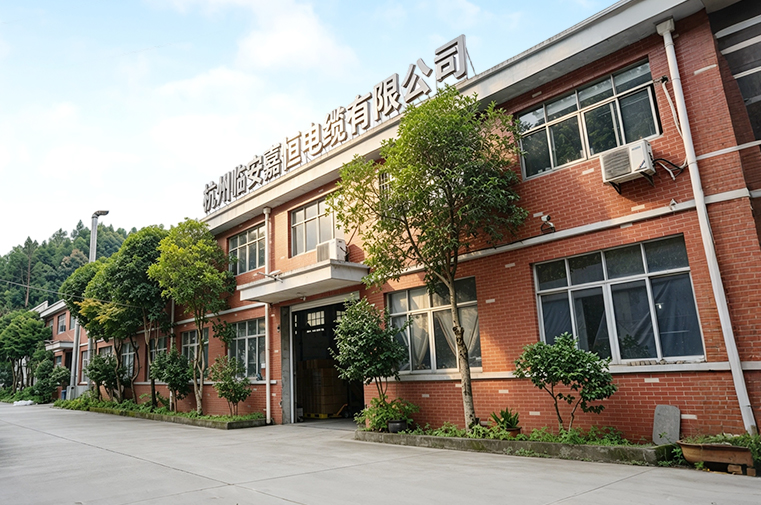
Corporate Vision
To serve as the "nerve fibers" of the global digital world, enabling every data center, every building and every household to run on Jiaheng cables.
OUR PRODUCTS ARE SOLD BOTH DOMESTICALLY AND INTERNATIONALLY, HELPING TO DRIVE INDUSTRY
UPGRADES.
OUR PRODUCTS ARE SOLD BOTH DOMESTICALLY AND INTERNATIONALLY, HELPING TO DRIVE INDUSTRY
UPGRADES.
News
View More
Keep Up To Date With Our Latest News.
Instrumentation Cable Industry knowledge
Instrumentation Cable From Our Factory in Hangzhou
Hangzhou Linan Jiaheng Cable Co., Ltd. designs and manufactures instrumentation cable for low-level signal transmission in industrial automation and process control loops. From our headquarters in Lin'an District, Hangzhou, we supply field-to-control-room cabling that connects transmitters, sensors, actuators, flow meters, analyzers, DCS and PLC equipment. As Custom Industrial Instrumentation Cable Manufacturers, we control pair twist, screening architecture and jacket selection so that 4-20 mA loops, thermocouple and RTD millivolt signals, RS-485 communication and discrete switching signals reach their destination without interference.
Our instrumentation cable range is part of our broader Products family, which also includes Ethernet, fire alarm, power and composite cables. The same factory that supports OEM network cable projects produces this instrumentation line, so procurement teams can consolidate their cable supply from one manufacturing partner in China.
Available Range and Configuration Options
We supply instrumentation cable from 1 pair to 24 pairs, with conductor sizes from 0.5 mm² to 2.5 mm². This covers single measurement points, package units, analyser shelters and full DCS marshalling runs. Jackets are available in V-90 PVC, LSZH and flame-retardant compounds, with optional steel wire armour for direct burial, tray installations and mechanically demanding routes.
| Pair Count | Typical Application | Screening and Jacket |
|---|---|---|
| 1 Pair 1.0 mm² | One 4-20 mA transmitter loop: pressure, level, flow or temperature | AL/PET foil overall; V-90 PVC or LSZH |
| 2 Pair 1.0 mm² | Two circuits on one route: pump stations, skids, HVAC controllers | Overall shield or individually screened pairs |
| 4 Pair 1.0 mm² | Four circuits in one containment route: skids, analyser shelters, PLC marshalling | AL/PET foil, optional foil-plus-braid or per-pair screens |
| Up to 24 pairs | Larger DCS marshalling and multi-loop consolidation | Overall foil plus copper braid; optional steel wire armour |
For pair counts beyond the listed examples, we build to your cable schedule using the same conductor, screen and jacket families.
Shielding, Pair Twist and Signal Integrity
Instrumentation signals are low in amplitude and easily corrupted. Our standard construction uses AL/PET foil screening: aluminium foil laminated to polyester film, applied with the conductive face inward and a full overlap. The foil blocks high-frequency EMI and RFI, while the polyester carrier keeps the thin foil from tearing during pulling and termination.
- Overall foil screen: sufficient for most 4-20 mA loops in a normal plant environment.
- Foil-plus-copper-braid: specified near VFDs, switchgear, motors and long parallel power routes.
- Individually screened pairs: recommended when millivolt thermocouple or RTD signals share a sheath with higher-level signals.
When multiple pairs share one sheath, crosstalk between adjacent pairs becomes the dominant risk. We control this with differential twist lay: each pair is twisted at a different rate so that coupled energy does not accumulate coherently along the cable. This manufacturing-controlled parameter is what allows several analogue signals to coexist in one cable without measurable error at normal plant distances.
Application Fit by Industry
This product family is suited to continuous process plants and discrete automation systems where analogue signals must be transported reliably over long distances. Typical sectors include petrochemical plants, power generation, metallurgy, water treatment, pharmaceuticals, food processing and building automation. Within those sectors, the cable is used for transmitters, valve positioners, I/P converters, analysers, pump stations, machine control panels and small DCS or PLC marshalling.
Our engineers evaluate the signal type, route and environmental conditions before recommending a shielding architecture. A single pair is the most economical choice for one measurement point; multi-pair construction reduces installation cost when several loops share a route, because one cable pull replaces several separate runs.
Critical Specifications and Materials
- Conductor: bare copper, 0.5 mm² to 2.5 mm², manufactured to IEC 60228 conductor classes.
- Construction reference: EN 50288-7 for instrumentation circuit cabling.
- Rated voltage: 300/500 V, suitable for IS loops where system parameters permit.
- Insulation and jacket: V-90 PVC rated for 90°C continuous operation, LSZH for low smoke and zero halogen, or flame-retardant compounds.
- Mechanical protection: optional steel wire armour and optional drain wires for easy screen termination.
Conductor size matters even at signal level because loop resistance adds directly to the transmitter's required drive voltage. The 1.0 mm² cross-section keeps loop resistance low on long field runs and provides mechanical robustness for terminations that will be disturbed during commissioning.
Installation, Termination and Earthing Practice
Screens only work when correctly bonded. For most instrumentation circuits, we recommend bonding the screen at one end only, normally the control room end, to prevent ground loops between earths at different potentials. Use wide-area bonding methods such as shield clamps or EMC glands rather than a thin twisted tail.
Before ordering, confirm the colour code and record it on the loop sheets and cable schedule. Ambiguous pair identification is one of the most common causes of commissioning delays, especially in 4-pair and larger cables. If the project uses numbered or banded cores, state that explicitly so the cable is manufactured with the required identification.
Quality Assurance and Project Support
We are a direct factory since 2008, focused on OEM and customized production. Our instrumentation cable is manufactured on the same production lines as our Ethernet and industrial wiring ranges, with material traceability from copper rod to finished drum. Every project is supported by a dedicated English-speaking engineer who can answer construction questions without routing you between departments.
Shipments are backed by copper purity certificates, insulation compound datasheets and pre-shipment QC reports with photos and test data. You approve the documentation before dispatch. This applies equally to a single-pair trial order and a multi-kilometer project rollout.
Information We Use to Configure Your Solution
To prepare a configuration and quotation, we start with the working point, not just the catalogue description. Send us the following project information:
- Signal types: 4-20 mA, thermocouple, RTD, RS-485, discrete or mixed.
- Number of loops and cable route length, including containment method and exposure to EMI.
- Required pair count, conductor size, screening architecture and jacket type.
- Armour, drain wires, colour code, marking and drum length requirements.
- Applicable standards, customer specification or project documentation.
- Quantity, target delivery date and shipping destination.
With these details, we can recommend the correct construction and provide a formal quotation with sample drawings, specifications and pre-production samples when needed.
Frequently Asked Questions
What pair counts and conductor sizes can you supply?
We supply instrumentation cable from 1 pair to 24 pairs and conductor sizes from 0.5 mm² to 2.5 mm². For standard projects we commonly build 1, 2 and 4 pair versions in 1.0 mm², and we extend to larger pair counts for DCS marshalling applications.
How do I choose between overall foil and individually screened pairs?
Overall AL/PET foil screening is normally sufficient for 4-20 mA loops in standard plant environments. If a thermocouple or RTD millivolt signal shares the same sheath as a higher-level signal, or if the route runs close to VFDs and power cabling, we recommend individually screened pairs or a foil-plus-copper-braid screen.
Can you supply LSZH, flame-retardant or armoured versions?
Yes. The range is available with V-90 PVC, LSZH and flame-retardant jackets, plus optional steel wire armour for mechanical protection. We select the jacket based on the environment, fire safety requirements and applicable installation code.
Do you support OEM branding and private label?
Yes. We are a direct factory with OEM-focused production and flexible MOQs. Your cable can be manufactured with your specified marking, packaging and documentation, and we do not sell our own brand in the markets where our partners operate.
What documentation do you provide with shipment?
Our standard shipment package includes copper purity certificates, insulation compound datasheets and pre-shipment QC reports with photos and test data. You review and approve the results before the cable leaves the factory.

Contact
-
 sales@jiahengcable.com
-
 +86-19357267601
-

-
 Heziwu, Shuangyuan Village, Linglong Subdistrict, Lin'an District, Hangzhou City, Zhejiang Province, P.R.China
Products
QR Code
Copyright © Hangzhou Linan Jiaheng Cable Co., Ltd. All Rights Reserved Custom Instrumentation Cable Suppliers

TO TOP