

 English
 Ethernet Cable
Home / Products / Ethernet Cable / CAT6 F/UTP LSZH Screened Cable 23AWG 4 Pair Foil Shielded for High-EMI Environments

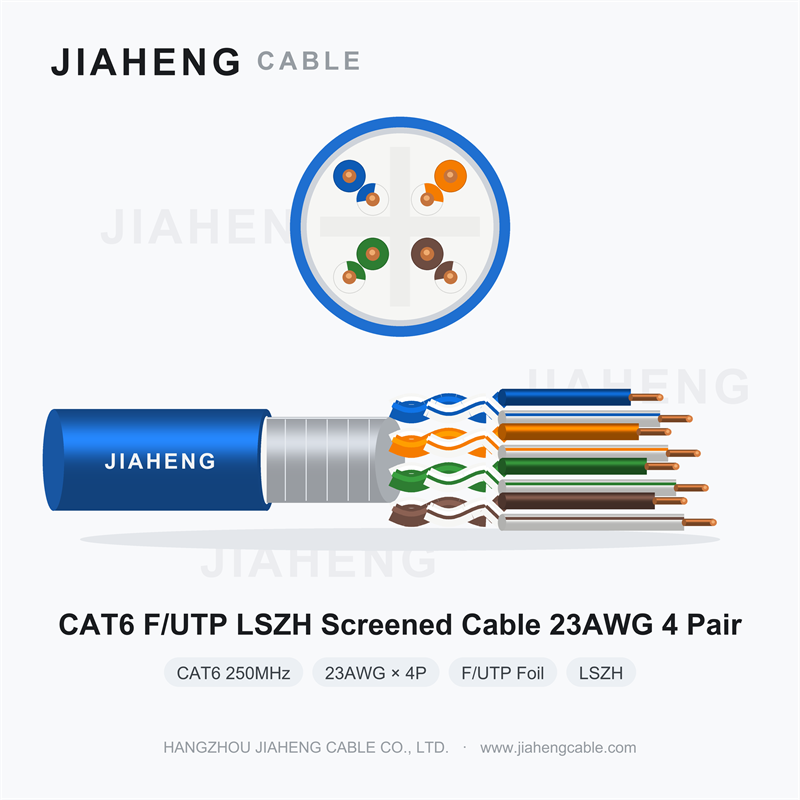
Confirmed Cable Specifications
• Category: CAT6 (Class E), bandwidth 250 MHz
• Shielding: F/UTP — Overall foil screen (individual pairs unshielded)
• Jacket: LSZH (Low Smoke Zero Halogen)
• Conductor size: 23AWG (approx. 0.57 mm diameter)
• Pairs: 4 pairs (8 cores)
1. Product Overview
CAT6 F/UTP LSZH 23AWG×4P is a 250 MHz four-pair data cable in which an aluminium foil screen wraps all four pairs inside an LSZH jacket, with 23AWG solid copper conductors. The "F" in F/UTP denotes an overall foil screen; the "UTP" portion means the individual pairs are not separately screened.
This is the cable to reach for when the environment — not the application speed — is the problem. Choosing between screened and unscreened is one of the most common and most consequential decisions in a cabling specification, and it is usually made badly, in both directions.
2. The Decision Framework: When Screening Is Worth Paying For
Screening costs more in material, more in installation time, and — most importantly — creates a new failure mode that unscreened cable does not have: a screen that is installed but never properly bonded performs worse than no screen at all, while giving everyone false confidence.
Specify F/UTP or better when one or more of these is true:
• The data route runs parallel or close to power feeders, motor cables, or VFD output conductors. Variable speed drive outputs in particular generate fast switching edges with rich high-frequency content, and these couple strongly into adjacent unscreened data pairs.
• The installation is industrial: manufacturing floors, process plants, water treatment, rail depots, where contactors, welders, cranes and large motors are ordinary background.
• The cable shares tray, duct or conduit with other services and physical separation cannot be achieved.
• The site has a documented EMC problem, or the network must meet an emission or immunity requirement that unscreened cabling has failed to achieve.
• Very long channel lengths are involved, where accumulated coupled noise becomes significant.
Specify UTP instead when the environment is ordinary office, retail, education or residential, where the nearest interference source is building lighting and socket outlets. In those conditions UTP is faster to install, needs no earthing verification, and performs entirely adequately. Paying for screening there buys complexity, not performance.
3. The Earthing Problem Nobody Budgets For
A foil screen is not a passive wrapper. It is a conductor, and it must be connected to a defined earth reference at the right points, with low-impedance contact over a wide area.
The consequences of getting this wrong are concrete:
• A screen floating at both ends contributes very little screening at the frequencies that matter, because it has no path to drain intercepted energy.
• A screen bonded at both ends in a building where the two earth references sit at different potentials will carry circulating current. That current flows in the screen, generates its own magnetic field, and can couple noise into the pairs it was installed to protect — the exact opposite of the intent.
• A screen terminated by twisting a thin tail of foil and drain wire under a plastic connector shell provides negligible contact area and poor high-frequency performance.
Correct practice: use shielded connectors, shielded patch panels and shielded outlets rated for the category; make the screen contact over a wide area (EMC gland, shield clamp or braided pigtail); and bond at one end for typical control and data installations, or at both ends with an equipotential bonding conductor where high-frequency performance demands it and the project specification says so. Budget the labour for this. It is real work, and it is where screened installations succeed or fail.
4. Why Overall Foil Rather Than Individual Pair Screening
F/UTP screens the cable as a whole. S/FTP screens each pair in foil and adds an overall braid. The distinction matters: individual pair screening addresses crosstalk between pairs inside the same cable, while overall screening addresses interference arriving from outside.
For most high-EMI scenarios the threat is external, so overall foil delivers the majority of the benefit at a fraction of the cost and complexity. Move to S/FTP when the cable also carries mixed signal types internally, or when the environment is severe enough (data centre rows, heavy industrial) that both threats must be addressed.
5. Foil, Drain Wire and Terminability
Aluminium foil alone is fragile and cannot be reliably connected. Two features make it usable: a polyester carrier film that gives the foil mechanical strength so it survives being pulled, and a drain wire running along the foil that provides something solid to terminate to.
Confirm the drain wire is present before ordering. A screened cable without one forces field technicians either to solder to foil (slow, unreliable, damages the jacket) or to leave the screen unconnected (which defeats the purpose).
6. LSZH Jacket and Conductor Sizing
The LSZH jacket serves the same fire-safety purpose as throughout this range: low smoke density and no corrosive halogen gases, required in enclosed and high-occupancy buildings. Note that screened cable is often specified for industrial sites where the LSZH requirement comes from the building's public areas rather than from the plant floor itself.
23AWG solid copper provides low conductor resistance, which supports both long-channel data performance and PoE operation. Screened cable in industrial environments frequently also powers field devices, making conductor size doubly relevant.
7. Applications
• Factory and process plant networks alongside motor and drive cabling
• Rail, metro, airport and tunnel installations with traction power nearby
• Data centres and equipment rooms with dense cable populations
• Buildings with documented EMC or network reliability issues
• CCTV and security systems in industrial or high-interference locations
• Any installation where data and power must share a route
8. Ordering Guidance
Confirm conductor material, foil construction and overlap, presence of a drain wire, overall diameter (which affects conduit fill calculations), and whether screened connectors, patch panels and outlets of matching category will be supplied as a system. A screened cable terminated with unscreened hardware is a wasted specification.
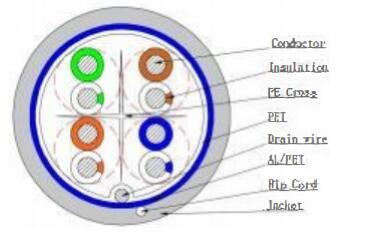
Technical parameter
| Type | CAT6 F/UTP 23AWG×4P |
| (mm) Specification | |
| Conductor | |
| Conductor material | BC |
| Conductor size | 23AWG×4P |
| ConductorConstruction(mm) | 0.56±0.01 |
| Insulation | |
| Insulation material | PE |
| Insulation diameter (mm) | 1.08±0.05 |
| AverageThickness (mm) | 0.2 |
| Min Thickness (mm) | 0.18 |
| Color | Blue, White-Blue, Orange, White-Orange, Green, White-Green, Brown, White-Brown |
| Fill | |
| Fill material | FR-PE Cross |
| Wrapping tape | |
| Wrapping tape material | PET |
| Drain wire | |
| Drain wire material | TC |
| Drain wire size(mm) | 1/0.4±0.01 |
| Shield | |
| Shield material | AL/PET |
| Rip-cord | |
| Rip-cord | Yes |
Detailed technical parameters
| Jacket | |||||||
| Jacket material | LSZH | ||||||
| Jacket diameter (mm) | 7.3±0.4 | ||||||
| Average Thickness (mm) | 0.65 | ||||||
| Min Thickness (mm) | 0.5 | ||||||
| Color | According to customer’s requirement | ||||||
| Electrical&PHsical Characteristic: | |||||||
| Conductor DCR 20℃ | ≤93.8 Ω/km | ||||||
| Characteristic Impedance(Ohm) | 100±15 | ||||||
| Operational Temperature | -20℃~+90℃ | ||||||
| Channel transmission performance(100M) | |||||||
|
Frequency (MHz) |
Attenuation (dB) |
NEXT (dB) |
PSNEXT (dB) |
ACRF (dB) |
PSACRF (dB) |
Return loss (dB) |
Delay (ns) |
| 1 | 1.9 | 65 | 62 | 64.2 | 61.2 | 19.1 | 521 |
| 4 | 3.5 | 64.1 | 61.8 | 52.1 | 49.1 | 21 | 504 |
| 8 | 5 | 59.4 | 57 | 46.1 | 43.1 | 21 | 500 |
| 10 | 5.5 | 57.8 | 55.5 | 44.2 | 41.2 | 21 | 498 |
| 16 | 7 | 54.6 | 52.2 | 40.1 | 37.1 | 20 | 496 |
| 20 | 7.9 | 53.1 | 50.7 | 38.2 | 35.2 | 19.5 | 495 |
| 25 | 8.9 | 51.5 | 49.1 | 36.2 | 33.2 | 19 | 495 |
| 31.25 | 10 | 50 | 47.5 | 34.3 | 31.3 | 18.5 | 494 |
| 62.5 | 14.4 | 45.1 | 42.7 | 28.3 | 25.3 | 16 | 492 |
| 100 | 18.6 | 41.8 | 39.3 | 24.2 | 21.2 | 14 | 491 |
| 200 | 27.4 | 36.9 | 34.3 | 18.2 | 15.2 | 11 | 490 |
| 250 | 31.1 | 35.3 | 32.7 | 16.2 | 13.2 | 10 | 490 |

 sales@jiahengcable.com
 +86-19357267601

 Heziwu, Shuangyuan Village, Linglong Subdistrict, Lin'an District, Hangzhou City, Zhejiang Province, P.R.China
Copyright © Hangzhou Linan Jiaheng Cable Co., Ltd. All Rights Reserved
