

 English
 Power Cable
Home / Products / Power Cable / RVVP 4 Core 1.0mm² Shielded Flexible Control Cable with Copper Braid Screen

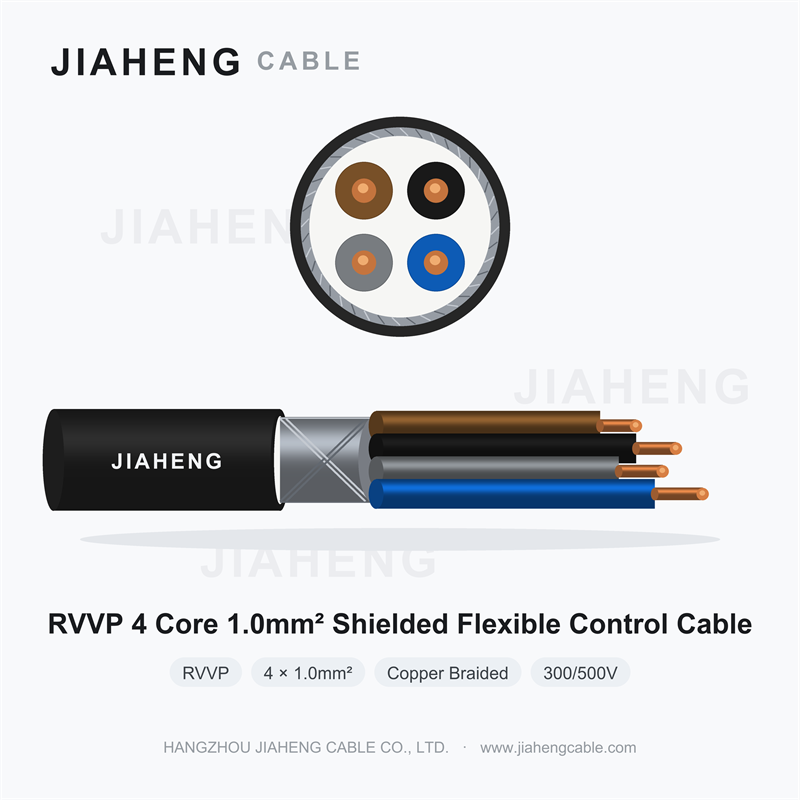
Confirmed RVVP Cable Specifications
• Model: RVVP (Flexible structure + PVC insulation + PVC sheath + Copper wire braided shield)
• Cores: 4
• Nominal cross-section: 1.0 mm2 per core
• Rated voltage: 300/300 V (common) — Please confirm with the manufacturer datasheet whether it is 300/300V or 300/500V
• Reference standard: JB/T 8734
• Screen: Copper wire braid
• Conductor structure: Stranded fine copper wires
• Max. conductor temperature: 70°C (Standard PVC grade)
1. Product Overview
RVVP 4×1.0mm² is a four-core shielded flexible control cable with multistrand copper conductors, PVC insulation, a copper wire braid screen and a PVC outer sheath. In the RVVP designation the trailing P stands for screened (屏蔽), and it is this braid that distinguishes the cable from plain RVV and defines what the product is for: running control and signal circuits in electrically noisy environments where an unscreened cable would pick up interference.
Four cores at 1.0 mm² suits the very common case of a control circuit that needs several conductors together — a device supply plus status, command and feedback signals — all inside one screened sheath.
2. What the Braid Screen Actually Does
The copper braid forms a continuous conductive enclosure around all four cores. It works in two directions at once:
• It intercepts externally generated electric fields from VFD output cables, contactor coils, motor feeds and power conductors running in the same tray, diverting them to earth rather than allowing them to couple onto the signal cores.
• It reduces the field the cable itself emits, which helps a machine or installation comply with electromagnetic compatibility requirements and prevents the control cable from disturbing nearby sensitive circuits.
Braid coverage is the specification that determines how well this works, and it is worth stating explicitly on the data sheet. A dense braid gives meaningfully better screening attenuation at the frequencies typical of switching devices than a sparse one.
3. Grounding the Screen
A braid screen only performs when it is properly bonded. Standard practice for control circuits is to terminate the screen to earth at one end — normally the cabinet or controller end — using a shield clamp, braided pigtail or EMC gland that makes contact over a wide area rather than a thin twisted tail. Single-ended bonding avoids circulating currents where the two ends of the run sit at different earth potentials. Where the project specification requires double-ended bonding for high-frequency performance, follow that specification and provide an equipotential bonding conductor alongside.
4. Applications
• Automation equipment interconnection: PLC to remote I/O, servo drives, encoders and sensors
• Variable frequency drive control circuits, where drive output is a strong interference source
• Security, CCTV and access control systems carrying power plus data in one screened cable
• Intercom, public address and door-phone installations
• Instrumentation and weighing systems, packaging machinery and machine tool control wiring
• Building management system field bus and controller wiring
5. Sizing the Circuit
1.0 mm² copper is appropriate for control and signal duty and for low-power device supply. It is not intended as a primary power feeder for significant loads. Where a circuit must carry appreciable current, check the voltage drop over the actual run length and confirm the load current is within the cable's capacity for the installed conditions, then protect the circuit with a suitably rated device.
6. Ordering Notes
Because four cores share one sheath, request the actual colour code and record it on the wiring diagram before shipment — mismatched expectations on core colours are a frequent cause of commissioning delays. Confirm braid coverage, conductor material and whether the rating is 300/300 V or 300/500 V, and state packing length. If the installation is exposed to oils, chemicals or continuous flexing on a drag chain, ask for the appropriate sheath compound or a dedicated flexible-chain cable instead.
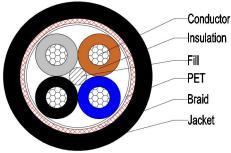
Technical parameter
| Type | RVVP 4×1.0mm² |
| (mm) Specification | |
| Conductor | |
| Conductor material | BC |
| ConductorConstruction(mm) | 32×0.2±0.01 |
| Insulation | |
| Insulation material | PVC |
| Insulation diameter (mm) | 2.6±0.1 |
| Average Thickness (mm) | 0.6 |
| Min Thickness (mm) | 0.44 |
| Color | Black, Grey, Blue, Brown |
| Fill | |
| Fill material | |
| Wrapping tape | |
| Wrapping tape material | PET |
| Braid | |
| Braid material | BC |
| Braid coverage | ≥80% |
| Jacket | |
| Jacket material | PVC |
| Jacket Diameter(mm) | 8.7±0.5 |
| Average Thickness(mm) | 0.9 |
| Min Thickness(mm) | 0.67 |
| Color | Black |
Detailed technical parameters
| Type | RVVP 4×1.0mm² |
| (mm)Specification | |
| Electrical&Physical Characteristic: | |
| Conductor DCR 20℃ | ≤19.5 Ω/km |
| Rated Voltage | 300/500V |
| Rated Temperature | -20℃~+70℃ |

 sales@jiahengcable.com
 +86-19357267601

 Heziwu, Shuangyuan Village, Linglong Subdistrict, Lin'an District, Hangzhou City, Zhejiang Province, P.R.China
Copyright © Hangzhou Linan Jiaheng Cable Co., Ltd. All Rights Reserved
