

 English
 Fire Alarm Cable
Home / Products / Fire Alarm Cable / 4 Core 18AWG LSZH Unshielded Fire Alarm Cable for Conventional Zoned Detection Systems

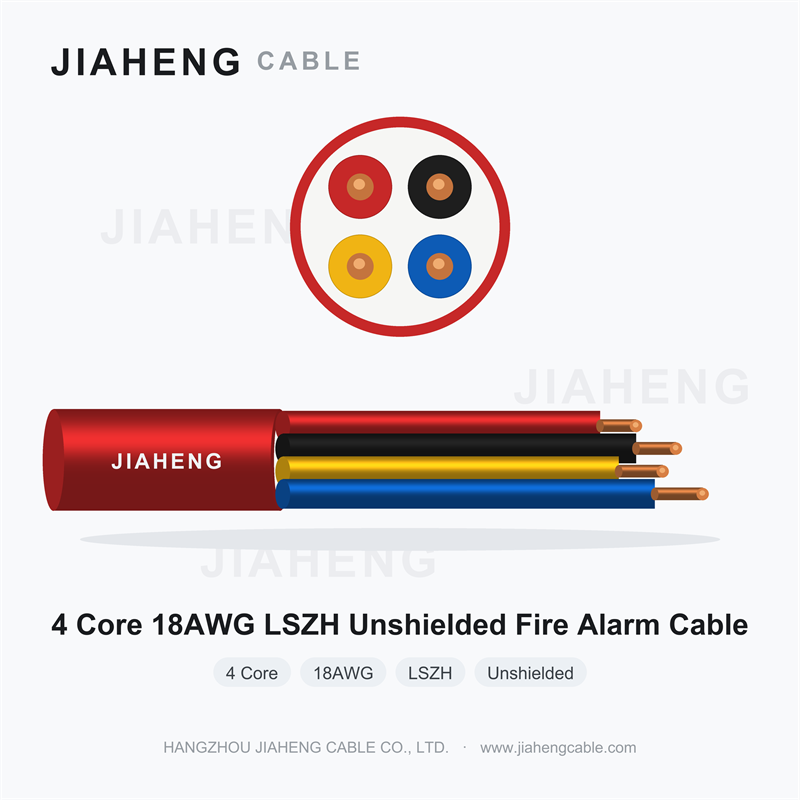
Confirmed Cable Specifications
• Cores: 4 cores (4C)
• Conductor size: 18AWG (approx. 0.82 mm²)
• Jacket: LSZH (Low Smoke Zero Halogen)
• Shielding: Unshielded (designated as non-shielded)
• Typical configuration: Two traditional detection zones (one pair per zone) / One detection loop + One alarm bell loop
1. Product Overview
This 4 core 18AWG LSZH unshielded fire alarm cable combines a four-conductor construction with a low-smoke halogen-free jacket and no metallic screening. It is a well-matched combination for a specific and very common situation: a conventional zoned detection system in a building where halogen-free materials are required, with two circuits running along one route.
Four cores is a deliberate middle ground. It offers the consolidation benefit of multi-core cable without the six-core version's larger diameter and colour-coding complexity, and it suits the natural pairing of conventional fire alarm circuits.
2. Why Four Cores Fits Conventional Systems
Conventional zoned fire alarm systems identify alarm locations by physical zone: each detection zone forms its own circuit back to the panel, and the panel indicates which zone has alarmed rather than which specific device. This architecture means circuits come in pairs very naturally.
Typical four-core allocations:
• Two detection zones, each using one pair — the most common use, giving two zones along one route with a single cable.
• One detection zone circuit plus one notification appliance circuit serving the same area.
• One detection zone plus one monitored input circuit for a door contact, flow switch or damper.
• One addressable loop pair plus a spare pair for future extension.
For a small commercial building, a retail unit, a school block or a hotel floor where two or three detection areas share a riser or corridor route, this cable removes the need for two separate runs and halves the containment, penetrations and terminations.
Addressable systems, by contrast, hang many devices on one loop pair and therefore need fewer conductors per route. Four-core cable remains useful in addressable installations for combining a loop pair with a sounder circuit or a power supply pair, but its most natural home is the conventional zoned system.
3. Conductor Size and What It Can and Cannot Do
18AWG (approximately 0.82 mm²) is appropriate for detection and signalling circuits, where currents are small and the limiting parameter is total loop resistance against the panel's specification.
It is not appropriate for long, high-current notification appliance circuits. Driving a string of sounders across a floor requires enough conductor cross-section to keep end-of-line voltage within the appliance's operating range, and 14AWG or larger is normally specified for that duty. Where a four-core cable allocates one pair to a sounder circuit, verify the voltage drop calculation against actual route length and load before accepting 18AWG.
The verification belongs to the project designer working against the applicable fire safety code and the panel manufacturer's data. Two checks are essential:
• Total loop resistance within the panel's specified maximum for each circuit.
• Voltage drop within appliance requirements for any circuit supplying power.
4. Unshielded: Appropriate Here, With Reason
Detection circuits are sometimes screened where interference is a documented concern. For most conventional zoned installations in commercial buildings, screening is unnecessary:
• Detector circuits carry low-level signals but are designed with end-of-line resistors and panel supervision that tolerate normal building electrical environments.
• The circuits are short relative to industrial signal loops.
• Unshielded construction eliminates the entire category of faults associated with improperly bonded screens — which, on a life-safety system, is a genuine reliability argument rather than just a cost one.
Specify screening only where the designer identifies a specific interference risk: cable routed parallel to power feeders or VFD output, installation in heavy industrial areas, or a documented history of spurious alarms attributable to induced noise. Where that risk exists, address it first by route separation, and use screened cable only when separation cannot be achieved.
A screening decision made without analysis is worse than no screening, because an unbonded or incorrectly bonded screen on a fire alarm circuit can itself become a fault path.
5. LSZH: Required Where People Are
The LSZH jacket is what makes this cable suitable for the buildings where fire alarm systems matter most — those with significant occupant density. Fire alarm cable runs along corridors, above escape routes, through stairwells and lobbies: the exact paths people use to leave a burning building.
Burning PVC releases hydrogen chloride, which forms hydrochloric acid on contact with moisture in the respiratory tract, and produces dense smoke that hides exit routes. LSZH compounds release substantially less smoke and no halogen-based acid gases, preserving visibility and reducing respiratory injury during evacuation.
This is why low-smoke halogen-free materials are mandated in high-rise escape routes, hospitals, schools, universities, cinemas, shopping centres, hotels, residential care facilities, underground stations, airports and tunnels. For fire alarm cable specifically, the requirement is difficult to argue against: a system installed to protect life should not itself contribute to the hazard.
Request IEC 60754 (halogen content and acid gas generation) and IEC 61034 (smoke density) test documentation for the product actually supplied, along with the fire performance class and its test report.
6. Applications
• Conventional zoned fire alarm systems in commercial, retail, education and hospitality buildings
• Two detection zones sharing one route in small to medium buildings
• Detection zone plus sounder or monitored input circuits along a common corridor or riser
• Fire alarm installations in hospitals, schools, hotels and shopping centres where LSZH is mandated
• High-rise buildings, escape routes, stairwells and lobbies
• Retrofit and extension projects in LSZH-regulated premises
• Addressable system installations where a loop pair is combined with a sounder or power pair
7. Installation Notes
• Maintain correct polarity and consistent core allocation across the whole installation; four cores forming two circuits leave little margin for improvisation.
• Support with appropriate fixings, using metal supports where the code requires circuit integrity under fire conditions.
• Segregate from power circuits by the applicable separation distance and do not share containment unless permitted.
• Verify loop resistance and end-of-line voltage during commissioning, and record measured values in the as-built documentation — a continuity test alone cannot confirm conductor adequacy.
• Label all four cores at both panel and field ends, and record the circuit allocation on the drawings.
8. Ordering Guidance
Confirm conductor material (oxygen-free bare copper is the appropriate choice for fire alarm circuits), conductor type, rated voltage, the actual core colour code, overall diameter, and — critically — the fire performance class with a test report for the supplied product plus the LSZH documentation. Provide the designer's circuit allocation and route lengths so conductor adequacy can be confirmed. State coil or drum length and printing requirements.
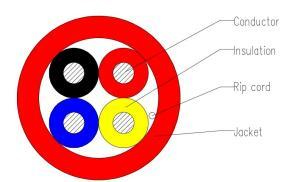
Technical parameter
| Type | Fire Alarm Cable 18AWG 4C LSZH Unshielded |
| (mm) Specification | |
| Conductor | |
| Conductor material | BC |
| ConductorConstruction(mm) | 1/1.02±0.01 |
| Insulation | |
| Insulation material | HDPE |
| Insulation diameter (mm) | 1.55±0.1 |
| Average Thickness (mm) | 0.25 |
| Color | Black, Red, Blue, Yellow |
| Rip-cord | |
| Rip-cord | Yes |
| Jacket | |
| Jacket material | LSZH |
| Jacket Diameter(mm) | 4.85±0.3 |
| Average Thickness(mm) | 0.55 |
| Color | Red |
Detailed technical parameters
| Type | Fire Alarm Cable 18AWG 4C LSZH Unshielded |
| (mm)Specification | |
| Electrical&Physical Characteristic: | |
| Conductor DCR 20℃ | ≤21.4 Ω/km |
| Rated Voltage | 300V RMS |
| Operational Temperature | -20℃~90℃ |

 sales@jiahengcable.com
 +86-19357267601

 Heziwu, Shuangyuan Village, Linglong Subdistrict, Lin'an District, Hangzhou City, Zhejiang Province, P.R.China
Copyright © Hangzhou Linan Jiaheng Cable Co., Ltd. All Rights Reserved
