

 English
 Instrumentation Cable
Home / Products / Instrumentation Cable / 1 Pair 1.0mm² AL/PET Foil Shielded Instrumentation Cable for 4-20mA Process Control Loops

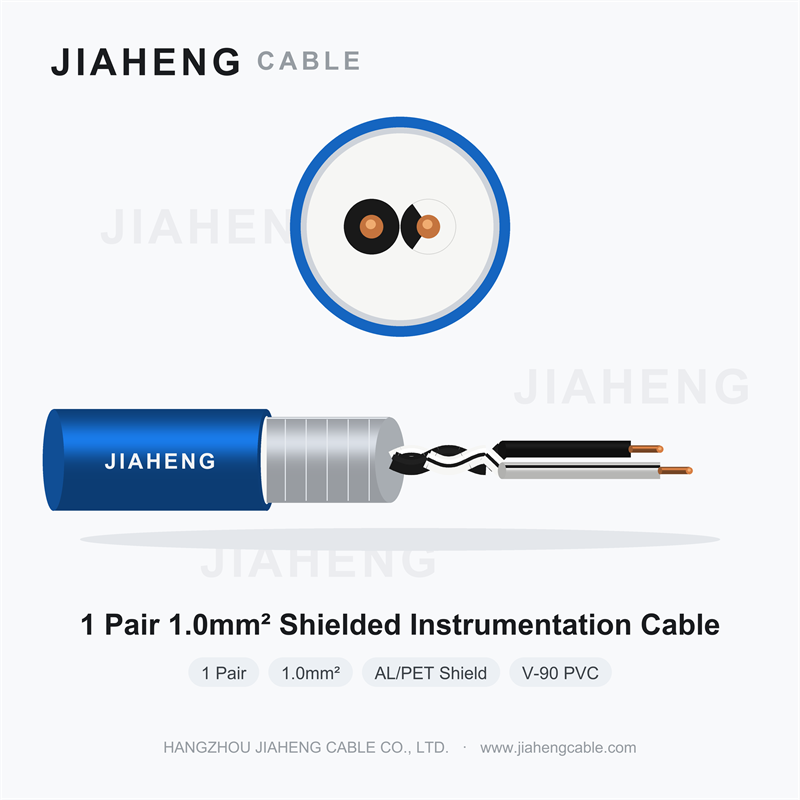
Confirmed by designation
• Pairs: 1 pair (2 cores)
• Conductor size: 1.0 mm²
• Screening: AL/PET foil tape (aluminium / polyester), overall
• Jacket: V-90 PVC, 90°C rated
• Rated voltage: 300/500 V (typical for IS/instrumentation circuits)
• Standard: EN 50288-7 / IEC 60228 class of conductor
1. Product Overview
This 1 pair 1.0 mm² instrumentation cable carries a single twisted pair inside an overall AL/PET foil screen, finished with a V-90 PVC jacket rated for continuous operation at 90°C. It is built for the most common task in process instrumentation: carrying a 4-20 mA analogue signal between a field transmitter and a control room I/O card, or between a sensor and a PLC analogue input.
A single pair is the natural choice where one measurement point occupies one circuit — a pressure transmitter, a level probe, a temperature converter or a flow meter output. Specifying a one-pair cable rather than a multi-pair construction avoids paying for unused conductors and keeps termination simple and unambiguous at both ends.
2. Construction
Conductor: 1.0 mm² copper, one pair, twisted together at a controlled lay length so that induced interference appears as a common-mode signal and is rejected by the differential receiver.
Screen: aluminium foil laminated to polyester film, applied with the conductive face inward and full overlap of the pair. The polyester carrier adds mechanical strength and prevents the thin foil from tearing during installation.
Jacket: V-90 PVC. The V-90 designation means the insulation compound is rated for 90°C conductor temperature, which allows a higher current-carrying capacity than standard V-75 constructions of the same size and improves behaviour in hot plant areas.
3. Why 1.0 mm² for Signal Loops
Although a 4-20 mA loop draws only milliamps, conductor size still matters. Loop resistance adds directly to the transmitter's required drive voltage; on long runs a thin conductor can push total loop resistance beyond the transmitter's compliance limit, causing signal clipping at the top of the range. The 1.0 mm² cross-section keeps loop resistance low enough for extended field-to-control-room runs, and provides mechanical robustness for direct burial in ducts, cable tray installations and terminations that will be disturbed during commissioning.
4. Applications
• Analogue process loops: pressure, level, flow, temperature and analytical transmitters
• PLC and DCS analogue input / output wiring
• Valve positioner and I/P converter signal circuits
• Intrinsically safe (IS) circuits where the applicable standard and entity parameters permit
• Retrofit and brownfield projects replacing older unshielded control wiring
5. Selection and Installation Notes
The foil screen must be terminated to be effective — an unterminated screen provides little benefit. Standard practice is to bond the screen at one end only (normally the control room end) to prevent ground loops between earths at different potentials. Where the circuit runs through an area with strong electromagnetic fields from VFDs, switchgear or large motors, consider upgrading to a foil-plus-braid construction or routing the cable in separated tray from power conductors.
Confirm the conductor material before ordering. Bare copper is the correct choice for fixed installations and for any circuit where corrosion or long-term contact resistance matters. Confirm also whether a drain wire is included, since this determines whether the screen can be terminated without soldering to the foil itself.

 sales@jiahengcable.com
 +86-19357267601

 Heziwu, Shuangyuan Village, Linglong Subdistrict, Lin'an District, Hangzhou City, Zhejiang Province, P.R.China
Copyright © Hangzhou Linan Jiaheng Cable Co., Ltd. All Rights Reserved
