

 English
 Fire Alarm Cable
Home / Products / Fire Alarm Cable / 6 Core 18AWG Fire Alarm Cable Multi-Circuit for Zoned Detection and Control Wiring

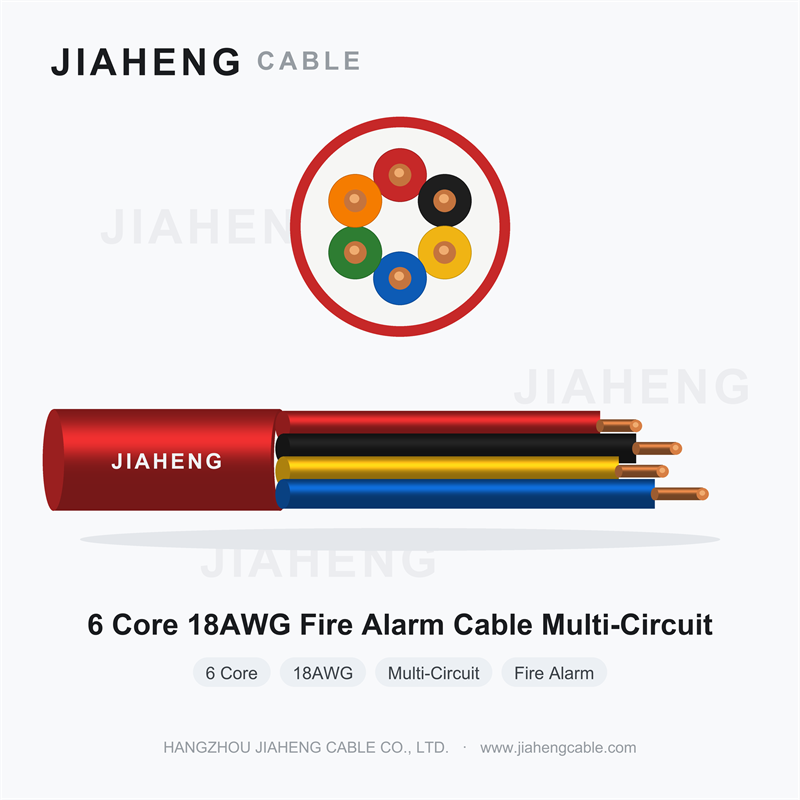
Confirmed Cable Specifications
• Cores: 6 cores (6C) — Multi-core integration, capable of supporting multiple circuits simultaneously
• Conductor size: 18AWG (approx. 0.82 mm²)
• Shielding: Not specified in designation — Please confirm: [ ] Unshielded [ ] Aluminum foil overall shield [ ] Other ___
• Jacket: Not specified in designation — Please confirm: [ ] PVC [ ] LSZH [ ] Other ___
• Typical circuits: Conventional zone detector circuit / linkage control / module power and signal combination
1. Product Overview
This 6 core 18AWG fire alarm cable puts six conductors inside one sheath, allowing several separate fire alarm circuits to share a single cable run. It is the consolidation option — the cable you reach for when a project needs multiple detector zones, control circuits or module connections running along the same route, and pulling six separate two-core cables would be wasteful in labour, containment and cost.
Where a two-core cable is defined by the circuit it serves, a six-core cable is defined by the opportunity it creates: fewer runs, fewer penetrations, fewer supports, and a considerably simpler cable schedule.
2. What Consolidation Actually Saves
On a typical fire alarm installation the cable itself is a small fraction of total cost. The majority sits in labour and materials around it:
• Containment. Every additional cable occupies conduit, trunking or tray space. Six two-core cables consume roughly six times the containment of one six-core cable, and containment is sized and priced accordingly.
• Pulling labour. Six separate pulls through the same route take far longer than one, and each pull risks damaging cables already installed.
• Penetrations and glands. Each cable entering a panel or crossing a fire compartment needs its own entry. Six entries mean more drilling, more glands, more fire-stopping material and more work to maintain the compartment's fire rating.
• Supports and fixings. Six cables need six sets of clips or ties at every support point.
• Termination and documentation. Six cables mean twelve terminations at the panel end versus six, plus six separate entries in the cable schedule instead of one.
• Fault-finding. A single, clearly documented multi-core cable with correct colour coding is easier to trace than a bundle of identical two-core cables.
3. How the Six Cores Get Used
Common configurations:
• Three conventional detector zones, each using one pair — a typical arrangement for a small building with three detection areas on one route.
• Two detector circuits plus one notification or control circuit.
• A conventional zone circuit plus associated sounder circuit plus a monitored input for a door or damper.
• Power supply conductors alongside signal conductors for remote modules or devices.
• Addressable loop plus spare conductors for future expansion or for a monitored end-of-line arrangement.
The right allocation depends entirely on the system design, the panel's circuit types and capacities, and the route. It must be decided by the designer and documented on the circuit diagrams before installation, not improvised on site.
4. Conductor Size and Circuit Verification
18AWG (approximately 0.82 mm²) suits detector and signalling circuits where currents are small. It is not sized for high-current notification appliance circuits spanning long distances — those normally require larger conductors such as 14AWG to keep end-of-line voltage within appliance requirements.
Two verifications are essential and belong to the designer:
• Loop resistance. The total resistance of each circuit must stay within the fire alarm panel's specified maximum. With six cores sharing one sheath, the same conductor size serves every circuit, so the longest circuit determines whether 18AWG is adequate for the whole cable.
• Voltage drop on any power-carrying core. Where cores supply power to devices or modules, drop must be calculated against load and length.
Also check cable capacitance per core against the panel's addressable loop limits if any of the six cores form part of an addressable loop — capacitance accumulates with length and can limit loop capacity before conductor resistance does.
5. Colour Coding: Non-Negotiable on Six Cores
Six cores in one sheath, potentially forming three separate circuits, is a configuration where misidentification causes real problems. Two cores swapped within a circuit may simply reverse polarity; two cores swapped between circuits can place a detector on a sounder circuit, causing a fault that is confusing to diagnose and potentially dangerous if it means a zone is not actually monitored.
Confirm the actual colour code before ordering and record it on the circuit diagrams, the cable schedule and the as-built documentation. Where cores are numbered rather than colour-distinguished, record the numbering convention. Where a project uses a specific colour standard, state it in the order. This small piece of administrative discipline prevents hours of commissioning troubleshooting.
6. Segregation Requirements
Fire alarm circuits must generally be segregated from power circuits, and in many codes from circuits of other systems, by defined separation distances or by separate containment. When several fire alarm circuits share one cable, that cable must be treated as a single fire alarm circuit for segregation purposes — a simplification, since one cable is easier to route away from power than six.
Note that mixing circuit types inside one cable (for example a signalling circuit and a notification circuit) must be checked against the applicable code and the panel manufacturer's instructions; some jurisdictions and some panel designs restrict which circuit types may share a cable.
7. Applications
• Small to medium buildings with several conventional detection zones on one route
• Retrofit projects where containment space is already constrained
• Industrial and warehouse installations with multiple monitored zones
• Buildings where several fire alarm circuits follow a common riser or corridor route
• Installations where reducing penetrations through fire compartments is a priority
• Projects with a defined requirement to consolidate circuits for cost or space reasons
8. Ordering Guidance
Confirm conductor material and type, rated voltage, the actual core colour code, jacket material (PVC or LSZH, depending on the installation location's requirements), shielding if the design calls for it, overall diameter for containment calculations, and the fire performance class supported by a test report for the supplied product. Provide the designer's circuit allocation so the correct construction can be confirmed, and state coil or drum length and printing requirements.
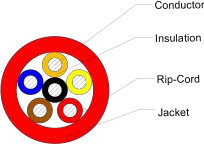
Technical parameter
| Type | 6C×18AWG Fire Alarm Cable |
| (mm) Specification | |
| Conductor | |
| Conductor material | BC |
| ConductorConstruction(mm) | 1.02±0.01 |
| Insulation | |
| Insulation material | PVC |
| Insulation diameter(mm) | 1.45±0.1 |
| Average Thickness(mm) | 0.2 |
| Min Thickness(mm) | 0.18 |
| Color | Black, Red, Brown, Blue, Orange, Yellow |
| Rip-cord | |
| Rip-cord | Yes |
| Jacket | |
| Jacket material | PVC |
| Jacket Diameter(mm) | 5.2±0.3 |
| Average Thickness(mm) | 0.38 |
| Min Thickness(mm) | 0.3 |
| Color | Red |
Detailed technical parameters
| Type | 6C×18AWG Fire Alarm Cable |
| (mm)Specification | |
| Electrical&Physical Characteristic: | |
| Conductor DCR 20℃ | ≤21.4 Ω/km |
| Max Operating Voltage | 300V RMS |
| Operating Temperature Range | -20℃~+75℃ |



 sales@jiahengcable.com
 +86-19357267601

 Heziwu, Shuangyuan Village, Linglong Subdistrict, Lin'an District, Hangzhou City, Zhejiang Province, P.R.China
Copyright © Hangzhou Linan Jiaheng Cable Co., Ltd. All Rights Reserved
