

 English
 Fire Alarm Cable
Home / Products / Fire Alarm Cable / 2 Core 18AWG PVC Fire Alarm Cable for Detector and Call Point Circuits

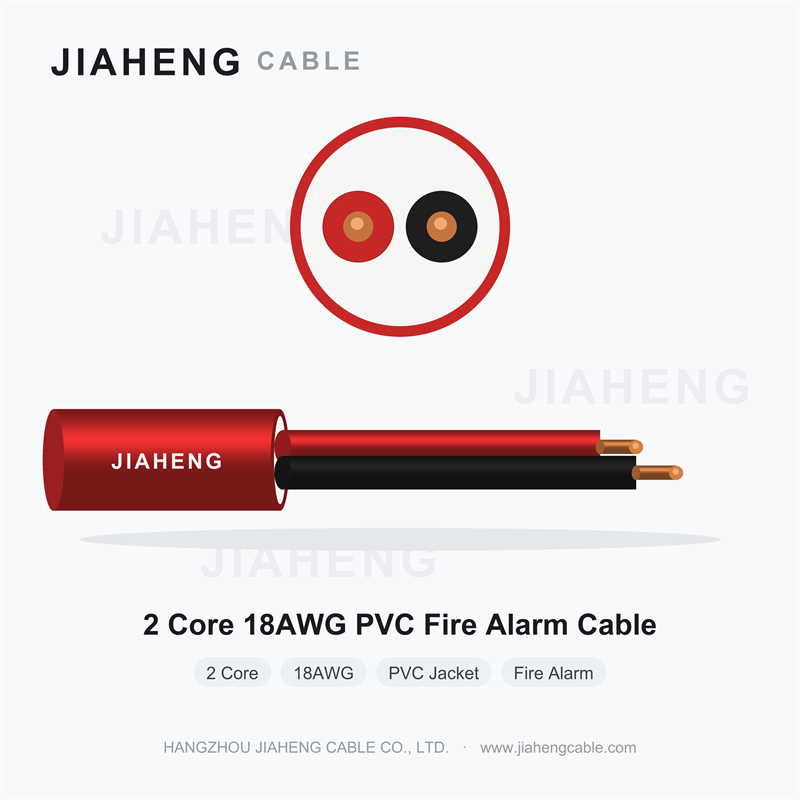
Confirmed Cable Specifications
• Cores: 2 cores (2C)
• Conductor size: 18AWG (approx. 0.82 mm²)
• Jacket: PVC (Non-LSZH)
• Shielding: Unshielded
• Typical circuit: Detector branch / Manual call point / Input module / Short-distance signal circuit
1. Product Overview
This 2 core 18AWG PVC fire alarm cable is an unshielded two-conductor cable with 18AWG conductors (approximately 0.82 mm²) and a PVC jacket. Where the 14AWG version exists to handle long, high-current notification circuits, this cable exists for the opposite case: shorter runs, lighter loads, and circuits where the conductor does not need to carry substantial appliance current.
It is the economical workhorse for detector spurs, call point connections and short module wiring — the circuits that make up the majority of cable runs in a typical fire alarm installation by count, even though they represent a minority of the total conductor copper.
2. Why 18AWG Is Right for These Circuits
Detector and signalling circuits behave very differently from notification circuits. An addressable detector loop carries digital communication rather than appliance drive current, and the currents involved are small. A conventional zone detector circuit monitors a series of detectors that draw only microamps in normal standby.
For these circuits, the limiting consideration is not appliance drive capability but total loop resistance against the panel's specification — the panel defines a maximum permissible loop resistance, and the design must stay within it. At 18AWG, permissible run length is shorter than at 14AWG, but for the distances these circuits typically cover — a spur to a call point, a branch to a group of detectors, a connection to an input module — the smaller conductor is entirely adequate and meaningfully cheaper.
Using 14AWG on every detector spur would add cost and stiffness without improving safety. Matching conductor size to actual circuit duty is good engineering, not cost cutting.
3. PVC Jacket: The Honest Trade-Off
This cable has a PVC jacket, not LSZH. That is a deliberate product choice with real consequences, and buyers should understand both sides.
What PVC provides:
• Lower cost per metre, which matters when a project has hundreds of short detector runs.
• Good mechanical durability and abrasion resistance during installation.
• Reliable performance in plant rooms, service areas, roof spaces and other non-public locations.
• Inherent flame retardancy from chlorine content, meeting single-flame and, in appropriate compounds, bundled-flame test requirements.
What PVC does not provide:
• Low smoke emission. Burning PVC produces dense, opaque smoke.
• Halogen-free combustion. It releases hydrogen chloride, which forms corrosive hydrochloric acid on contact with moisture in lungs and on equipment.
4. Where This Cable Belongs — and Where It Does Not
Appropriate locations for PVC-jacketed fire alarm cable:
• Plant rooms, mechanical and electrical service spaces, roof voids and basements that are not occupied or publicly accessible.
• Industrial buildings, warehouses and manufacturing areas without public occupancy.
• Locations where the applicable building code does not mandate halogen-free materials.
• Concealed runs in non-public parts of a building, where the LSZH requirement is tied to occupied spaces rather than to all cable.
Locations where the LSZH version should be specified instead:
• Escape routes, corridors, stairwells, lobbies and any egress path.
• Hospitals, schools, universities, cinemas, shopping centres, hotels and residential care facilities.
• Underground stations, airports, tunnels and other enclosed transport infrastructure.
• High-rise buildings above the specified height threshold in the applicable code.
• Any location where the project specification, national code, insurer or approving authority requires low-smoke halogen-free cabling.
The distinction matters more here than for general data cabling, because fire alarm cable runs exactly along the routes people use to escape. If the project location is uncertain or the cable will pass through mixed areas, specify LSZH — the cost difference is small compared with the cost of failing inspection or, worse, of compromising the very system installed to protect life.
5. Circuit Design Considerations
Even on short runs, the design must be verified:
• Confirm total loop resistance stays within the fire alarm panel's specified maximum for the circuit type.
• Verify voltage drop for any circuit that supplies power to devices, not only for pure signalling loops.
• Check the panel's capacity for the number of devices on the loop and the cable's capacitance per metre, which affects addressable loop length limits.
• Where an addressable loop runs long distances, the smaller conductor may become the limiting factor rather than device count — recalculate rather than assuming.
These calculations belong to the project designer working against the applicable fire safety code and the panel manufacturer's specifications. Cable data sheets supply the inputs; they do not replace the calculation.
6. Applications
• Conventional zone detector circuits in non-public areas
• Manual call point connections and spur wiring
• Input and output module connections to monitored equipment
• Detector branches in plant rooms, warehouses and industrial buildings
• Short interconnections within fire alarm equipment enclosures
• Retrofit and maintenance replacement wiring in locations where PVC is permitted
7. Installation Notes
• Maintain correct polarity; many panels and devices are polarity-sensitive.
• Support the cable with appropriate fixings, using metal supports where the code requires circuit integrity to be maintained under fire conditions.
• Segregate from power circuits by the applicable separation distance.
• Do not share containment with circuits of a different system unless the code and the designer permit it.
• Label at both ends and record the circuit in the as-built documentation.
8. Ordering Guidance
Confirm conductor material and type, rated voltage, core colours, and the fire performance class with the actual test report for the supplied product. Before ordering, verify against the project specification and the building code that PVC is permitted at the intended installation location. State coil or drum length and printing requirements. If the installation location is at all uncertain, ordering the LSZH version removes the compliance risk.
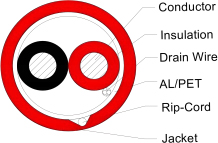
Technical parameter
| Type | 2C×18AWG Fire Alarm Cable |
| Specification | |
| Conductor | |
| Conductor material | BC |
| Conductor Construction (mm) | 1.02±0.01 |
| Insulation | |
| Insulation material | PVC |
| Insulation diameter (mm) | 1.45±0.1 |
| Average Thickness (mm) | 0.2 |
| MinThickness (mm) | 0.18 |
| Color | Black, Red |
| Drain Wire | |
| DrainWire material | TC |
| Drain Wire diameter (mm) | 7x0.245±0.01 |
| Shield | |
| Shield material | AL/PET |
| Rip-cord | |
| Rip-cord | Yes |
Detailed technical parameters
| Type | 2C×18AWG Fire Alarm Cable |
| Specification | |
| Jacket | PVC |
| Jacket Diameter (mm) | 3.80±0.2 |
| Average Thickness (mm) | 0.38 |
| MinThickness (mm) | 0.3 |
| Color | Red |
| Electrical & Physical Characteristics: | |
| Conductor DCR 20℃ | ≤21.4Ω/KM |
| Operating Temperature Range | -20℃ ~+75℃ |
| Max. Operating Voltage | 300V RMS |



 sales@jiahengcable.com
 +86-19357267601

 Heziwu, Shuangyuan Village, Linglong Subdistrict, Lin'an District, Hangzhou City, Zhejiang Province, P.R.China
Copyright © Hangzhou Linan Jiaheng Cable Co., Ltd. All Rights Reserved
