

 English
 Fire Alarm Cable
Home / Products / Fire Alarm Cable / 2 Core 14AWG LSZH Fire Alarm Cable for Notification Appliance Circuits and Sounder Loops

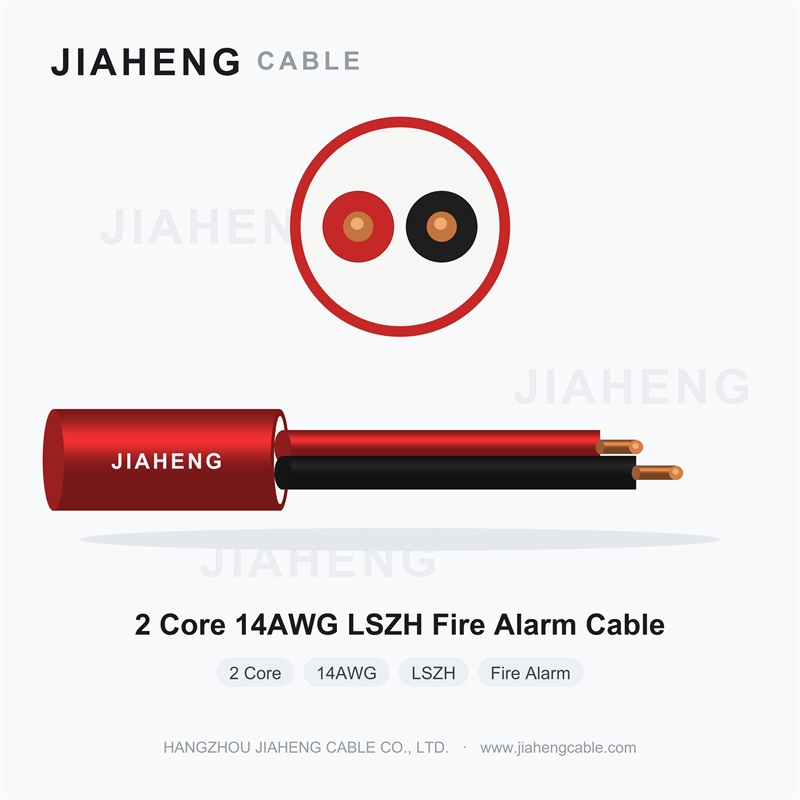
Confirmed Cable Specifications
• Cores: 2 cores (2C)
• Conductor size: 14AWG (approx. 2.08 mm²)
• Jacket: LSZH (Low Smoke Zero Halogen)
• Shielding: Unshielded (designated as non-shielded)
• Typical circuit: Notification Appliance Circuit (NAC) / 24V power circuit / Storable alarm power supply
1. Product Overview
This 2 core 14AWG LSZH fire alarm cable is an unshielded two-conductor cable with an unusually large cross-section for its class — 14AWG corresponds to approximately 2.08 mm², well above the 18AWG (about 0.82 mm²) more commonly seen in detector circuits. That size is not incidental. It identifies the circuit this cable is meant to serve: the notification appliance circuit, where current is high, runs are long, and the voltage that actually arrives at the last sounder determines whether the alarm is heard.
Two conductors, large cross-section, low-smoke halogen-free jacket. Read together, this is a cable for driving sounders and beacons across a building, in premises where the smoke produced by burning cable is itself a life-safety concern.
2. The Voltage Drop Problem in Notification Circuits
A notification appliance circuit works by pushing current through a series of sounders, horns, beacons or loudspeakers distributed along a route that may span a floor, a wing or an entire tower. Every sounder needs a minimum operating voltage to produce its rated sound output. The panel supplies a defined voltage at the start of the circuit. Everything in between is lost in the cable.
The loss is straightforward physics: voltage drop equals current multiplied by conductor resistance, and conductor resistance is inversely proportional to cross-sectional area and directly proportional to length. So a long circuit with a thin conductor can deliver noticeably less voltage at the far end than at the panel — and a sounder operating below its rated voltage produces less acoustic output.
This failure mode is dangerous precisely because it is silent. The panel shows the circuit as healthy. Current flows. The system reports normal. But in a real fire, the sounder furthest from the panel may not reach the required sound pressure level in the space it is supposed to protect — and the occupants in that space are the ones who need the warning most.
Specifying 14AWG rather than 18AWG roughly quadruples the conductor cross-section and correspondingly reduces resistance per metre. That is why larger conductors are standard for NAC runs and for any circuit where appliances are distributed over distance.
3. Sizing Is a Design Calculation, Not a Rule of Thumb
The correct conductor size depends on the actual circuit: total load current, number and type of appliances, route length, permissible end-of-line voltage, and the appliance manufacturer's minimum operating voltage. It must also account for how the cable is installed — in conduit, in tray, bundled with other circuits — because installation method affects temperature rise and therefore current-carrying capacity.
This calculation must be performed by the project designer against the applicable fire safety and electrical code. Cable suppliers can provide the conductor resistance data the calculation requires, but the sizing decision and the resulting compliance responsibility sit with the designer and the approving authority. Treat any generic "14AWG is enough for NAC" statement as a starting assumption to be verified, never as a design conclusion.
4. Why Unshielded Here
Detector and signalling circuits are often sensitive to interference, and may warrant screening. Notification appliance circuits are different: they carry relatively high current at low impedance to drive electromechanical or piezoelectric sounders. These loads are far less susceptible to induced noise than millivolt sensor signals, and the circuit's own current dominates anything coupled from outside.
Unshielded construction is therefore normal and appropriate for NAC. It also simplifies installation — no screen to bond, no drain wire to manage, no risk of a floating screen creating a fault path — which matters on circuits that may run hundreds of metres across a building.
Where a specific project places notification cabling adjacent to heavy power or in a location with documented interference affecting appliance operation, that should be assessed by the designer and addressed through route separation first, screening only if separation is not achievable.
5. Why LSZH Matters Most on Fire Alarm Cable
There is an uncomfortable logic to fire alarm cable in occupied buildings: it is installed precisely where people are, along escape routes, above corridors, in stairwells and lobbies. If a fire develops, this cable is among the first to be involved, and it runs through the paths people must use to get out.
A PVC-jacketed cable in that position releases hydrogen chloride and dense black smoke. The hydrogen chloride forms hydrochloric acid on contact with moisture in lungs and causes respiratory injury; the smoke obscures exit routes and disorients occupants. In most building fires, smoke inhalation — not flame — is what kills.
LSZH compounds are formulated to release far less smoke and no halogen-based acid gases. The practical effect is longer visibility, less respiratory injury, and more time for evacuation. That is why low-smoke halogen-free materials are mandated in enclosed and high-occupancy locations: high-rise escape routes, underground stations, airports, hospitals, cinemas, shopping centres, tunnels and schools.
For a fire alarm circuit — whose entire purpose is to protect life during a fire — specifying an LSZH jacket is not an optional upgrade. In regulated premises it is a requirement, and even where it is not mandated it is difficult to justify the alternative. Request IEC 60754 and IEC 61034 test documentation for the product actually supplied.
6. Applications
• Notification appliance circuits: sounders, horns, beacons and strobes
• Emergency voice alarm and loudspeaker circuits where conductor size suits the load
• 24 V power circuits supplying remote modules and appliance groups over distance
• Fire alarm systems in high-rise buildings, hospitals, hotels, shopping centres and transport hubs
• Escape route and stairwell installations where LSZH is required
• Conventional zoned systems where each notification zone forms a dedicated circuit
7. Installation Notes
Because these circuits are life-safety circuits, workmanship matters more than usual:
• Maintain correct polarity throughout. Reversed polarity can prevent appliances operating correctly and complicates fault finding.
• Use the specified fire-resistant or flame-retardant accessories — glands, clips, fixings — and support the cable with metal fixings where the code requires, so that the circuit remains intact if combustible supports fail.
• Segregate fire alarm cabling from power circuits per the applicable code separation distances; sharing containment can compromise both circuits in a fire.
• Verify end-of-line voltage and appliance output during commissioning, not just circuit continuity. A continuity test cannot detect an undersized conductor.
• Label circuits clearly at both panel and field ends for future maintenance.
8. Ordering Guidance
Confirm conductor material (oxygen-free bare copper is the appropriate choice for fire alarm circuits), conductor type, rated voltage, core colours and — critically — the fire performance class supported by an actual test report for the product being supplied. Provide the designer's calculated requirements for conductor size and fire performance rather than relying on a generic specification. State coil or drum length, printing requirements and the LSZH documentation to be supplied.
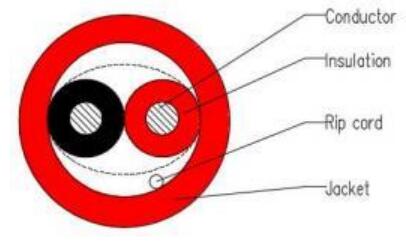
Technical parameter
| Type | 2C×14AWG LSZH Unshielded Fire Alarm Cable |
| (mm) Specification | |
| Conductor | |
| Conductor material | BC |
| Conductor size | 2C×14AWG |
| ConductorConstruction(mm) | 1.63±0.01 |
| Insulation | |
| Insulation material | HDPE |
| Insulation diameter(mm) | 2.15±0.1 |
| Average Thickness(mm) | 0.25 |
| Color | Black,Red |
| Rip cord | |
| Rip cord | Yes |
| Jacket | |
| Jacket material | LSZH |
| Jacket diameter(mm) | 5.40±0.3 |
| Average Thickness(mm) | 0.55 |
| Color | According to customer's requirement |
Detailed technical parameters
| Type | 2C×14AWG LSZH Unshielded Fire Alarm Cable |
| Specification | |
| Electrical&Physical Characteristics: | |
| Conductor DCR 20℃ | ≤8.45 Ω/km |
| Operational Temperature | -20℃~+90℃ |
| Rated Voltage | 300V |



 sales@jiahengcable.com
 +86-19357267601

 Heziwu, Shuangyuan Village, Linglong Subdistrict, Lin'an District, Hangzhou City, Zhejiang Province, P.R.China
Copyright © Hangzhou Linan Jiaheng Cable Co., Ltd. All Rights Reserved
