

 English
 Industry News
Home / News / Industry News / Cat5e vs Cat6 vs Cat6a: Which Ethernet Network Cable Fits Industrial and Commercial Networks?

Content
Switches, access points and industrial controllers attract most of the attention during a network upgrade, yet the copper between them quietly sets the ceiling for every link. A well chosen ethernet network cable can carry gigabit traffic for fifteen years or more, while a mismatched one produces retransmissions, link flaps and intermittent faults that are expensive to trace once the ceilings are closed.
The choice between Cat5e, Cat6 and Cat6a is therefore less about today's port speed and more about the service life of the installation. Labor, conduit and pathway access usually cost several times more than the cable itself, so the cable category is the decision that is hardest to reverse. This guide compares the three categories by bandwidth, reach, construction, shielding, power delivery and environment, so engineers and buyers can specify with confidence for commercial buildings and factory floors alike.
Key takeaway: Select the category for the network you expect to run in ten years, not the one you run this quarter. Upgrading a switch takes an afternoon; re-pulling cable takes a project plan.
Cat5eCat6Cat6aUTPF/UTPS/FTP
All three categories use four twisted copper pairs and the same RJ45 connector, which hides how different their performance envelopes are. The table summarizes the rated characteristics that matter most during specification.
| Category | Bandwidth | Typical Conductor | 10G Reach | Typical Use |
|---|---|---|---|---|
| Cat5e | 100 MHz | 24 AWG | Not specified | Basic office drops |
| Cat6 | 250 MHz | 23 to 24 AWG | Up to 55 m | Commercial buildings |
| Cat6a | 500 MHz | 22 to 23 AWG | 100 m | Backbones, access points |
Bandwidth is the clearest separator. Cat5e is characterized to 100 MHz, Cat6 to 250 MHz and Cat6a to 500 MHz. A wider characterized range means the cable is tested for crosstalk and attenuation across more frequencies, which is what keeps 10 Gbps signaling reliable over a full 100 m channel.
Figure 1. Rated frequency range of each category.
For many commercial sites Cat6 is the balanced middle option: it handles gigabit and multigigabit traffic comfortably and costs less to install than Cat6a. Cat5e remains acceptable for low-density office drops, while Cat6a is the safer choice for wireless access points, camera backbones and any link that may later move to 10 Gbps.
Cat5e typically uses 24 AWG solid copper with moderate twist rates. Cat6 tightens the twist and usually adds a plastic cross-shaped separator, often called a spline, that holds the pairs apart and reduces near-end crosstalk. Cat6a goes further with larger conductors, often 23 AWG, a thicker jacket and a more rigid separator, which is why it is noticeably heavier and stiffer to handle.
Unshielded twisted pair (UTP) relies on twist geometry alone to reject noise. Foil shielded designs (F/UTP) add an overall foil, while S/FTP adds an individual foil on each pair plus an overall braid. At 10 Gbps the main threat is alien crosstalk, which is interference from neighboring cables in a tray or conduit. Cat6a UTP controls it with extra diameter and spacing, while shielded Cat6a controls it with metal barriers and can therefore be thinner and more flexible.
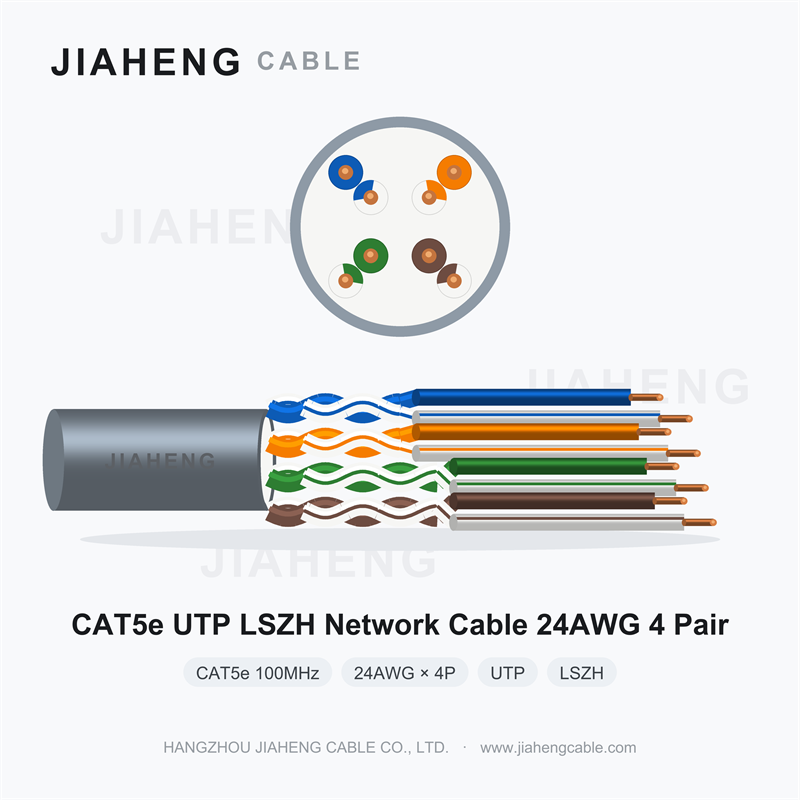
Figure 2. Four twisted pairs inside a low smoke zero halogen jacket.
Ethernet over twisted pair has climbed from 100 Mbps to 40 Gbps in two decades, and each jump pulled a new cable category into the mainstream. The chart shows the timeline of the top standardized copper speeds.
Figure 3. Milestones in copper Ethernet speed.
Reach is where the categories diverge. All three support 1 Gbps over a 100 m channel. Multigigabit options extend their life: 2.5GBASE-T runs on Cat5e and 5GBASE-T on Cat6, both up to 100 m, which lets operators lift wireless uplinks without recabling. 10GBASE-T is the real test. Cat6a delivers it to the full 100 m, Cat6 is limited to roughly 37 to 55 m depending on alien crosstalk, and Cat5e is not specified for it. Cat8 supports 25 and 40 Gbps but only to 30 m, so it suits equipment rows rather than general building cabling.
A Cat6 channel has less noise margin, so tight bundling, long parallel runs and dense patch panels can pull 10 Gbps reach well below 55 m. Mitigation means wider spacing, shorter runs and field certification. If a route exceeds about 50 m and 10 Gbps is plausible, Cat6a is the sensible default.
Electrical noise is a leading cause of intermittent faults in factories, where variable frequency drives, welders, large motors and relay panels all radiate interference. A shielded twisted pair LAN cable places a conductive barrier around the pairs so that noise is diverted to ground instead of coupling into the signal. In these settings, industrial ethernet cable with foil or braid shielding is frequently the more dependable choice, while UTP remains perfectly adequate in offices and control rooms.
Figure 4. Illustrative planning scores, higher is better.
The radar shows the trade-off clearly. Cat6a leads in bandwidth, crosstalk control and 10G reach, while Cat5e wins on ease of installation and cost. Cat6 sits between them, which explains its popularity in mixed projects.
A shield only helps when it is bonded correctly. Terminate the shield through shielded connectors with full 360 degree contact, bond it at the patch panel, and keep ground potential differences between buildings low. Otherwise the shield can carry loop currents and act like an antenna. As a rule of thumb, keep parallel runs at least 200 mm from unshielded power conductors, and increase that distance near drives and large motors.
Cameras, wireless access points, lighting and sensors now draw power through the same cable that carries data. The standardized levels, measured at the switch port, are:
Current heats the conductors, and inside a dense bundle that heat has nowhere to go. Larger conductors have lower DC resistance, so they run cooler and waste less power over distance. That is a practical argument for Cat6a, whose 22 to 23 AWG conductors stay cooler than the 24 AWG of Cat5e at equal current. In warm ceiling spaces, limit bundle sizes when delivering high wattage and follow the standard guidance on temperature rise. Never accept copper-clad aluminum for powered links.
The jacket decides where a cable may legally and physically be installed. The table lists the most common options.
| Jacket | Best Environment | Key Property |
|---|---|---|
| PVC | General indoor offices | Low cost, flexible |
| LSZH | Tunnels, data rooms, transit | Low smoke, no halogen gas |
| PE | Outdoor and buried routes | UV and moisture resistance |
| PUR | Oil and moving machinery | Abrasion and chemical resistance |
Figure 5. Typical outer diameters, which vary by design.
Diameter drives pathway planning. Conduit fill is commonly limited to 40 percent when three or more cables share a pipe, so a thicker Cat6a UTP cable reduces how many drops fit in an existing route. Respect the minimum bend radius, normally four times the cable diameter for unshielded types and often eight times for shielded types, and keep pulling tension within the manufacturer limit, typically 110 N.
A repeatable sequence prevents the two most common errors: over-specifying low-value drops and under-specifying backbone links.
Figure 6. From requirements to a certified installation.
Large projects are usually purchased as bulk ethernet cable in 305 m boxes or longer reels, so a small quality defect repeats across thousands of meters. A dependable Cat6 network cable supplier should be able to provide the evidence below before an order is placed, and any high speed network cable claim on packaging should be backed by test reports rather than marketing language.
Always request a sample reel and certify a few permanent links with a field tester before approving the full order. Compare the measured margins against the target category, and check that the length markings are accurate, because short boxes quietly raise the real cost per meter.
The difference is bandwidth and crosstalk performance. Cat5e is rated to 100 MHz, Cat6 to 250 MHz and Cat6a to 500 MHz. Only Cat6a supports 10 Gbps across the full 100 m, while Cat6 reaches about 55 m at that speed.
Often yes, because it handles gigabit and multigigabit traffic well. If runs exceed 55 m, or 10 Gbps uplinks to access points and cameras are likely, Cat6a is the better long-term choice.
Choose shielded cable near drives, welders and large motors, in dense trays carrying 10 Gbps, or wherever interference has caused faults. It only works with correct grounding, so plan termination and bonding first.
They will connect, but the link performs at the level of its lowest rated component. A true Cat6a channel needs Cat6a cable, connectors, panels and patch cords throughout.
The standard channel limit is 100 m, usually made up of a 90 m permanent link plus 10 m of patch cords. Longer distances need a switch, media converter or fiber link.
Check conductor material and gauge, jacket fire rating, diameter, length marking accuracy and independent test reports. Then certify a sample run with a field tester before approving the order.

 sales@jiahengcable.com
 +86-19357267601

 Heziwu, Shuangyuan Village, Linglong Subdistrict, Lin'an District, Hangzhou City, Zhejiang Province, P.R.China
Copyright © Hangzhou Linan Jiaheng Cable Co., Ltd. All Rights Reserved Custom Industrial Wire and Cables Suppliers
