

 English
Industry News
Home / News / Industry News / F/UTP vs. U/UTP Cat6 Cables: Foil Shielding in EMI-Intense Environments

Content
Specifying Cat6 cabling for an electrically noisy factory floor or a densely patched data hall usually ends with the same question: does the foil inside an F/UTP cable actually buy anything over an unshielded U/UTP design? The honest answer is that a screen changes the physics of the link, the labour content of the installation and the cost of the bill of materials all at once. This guide compares F/UTP and U/UTP Cat6 construction, explains how a foil barrier behaves under electromagnetic interference (EMI), and sets out the conditions under which each type is the more sensible engineering choice.
Both cables are Cat6, both use 23AWG copper conductors in four twisted pairs, both are designed for a nominal 100 ohm impedance and a 250 MHz bandwidth, and both are tested against component requirements such as TIA-568.2-D and ISO/IEC 11801-1. The divergence is entirely in the barrier around the core.
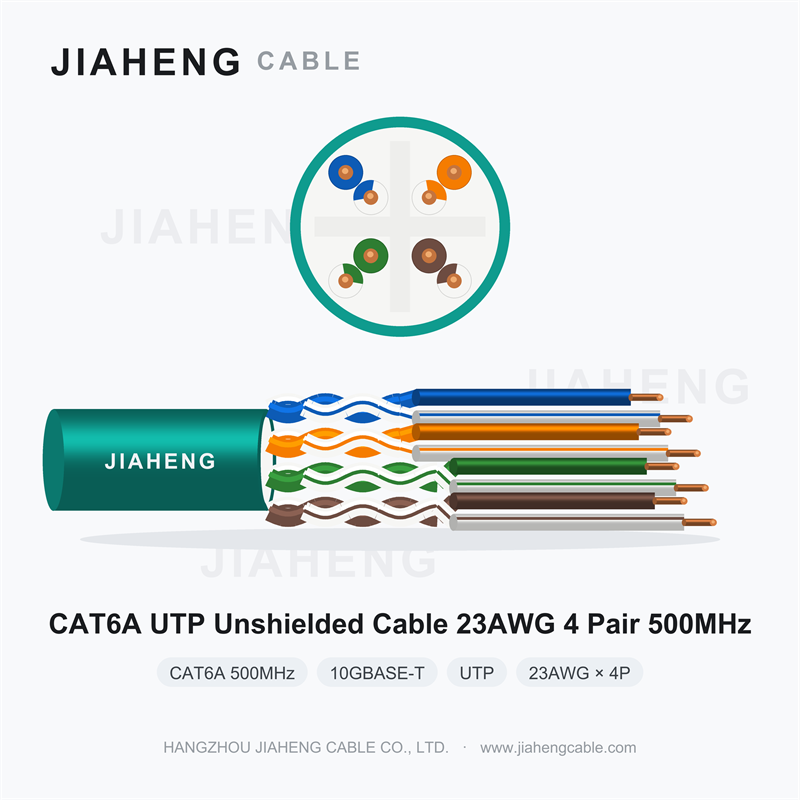
In a U/UTP cable, the four pairs are twisted at carefully chosen lay lengths around a spline separator and then jacketed. Noise rejection comes from balance: each conductor of a pair picks up nearly identical interference, and the differential receiver subtracts the common-mode component. Nothing metallic surrounds the pairs.
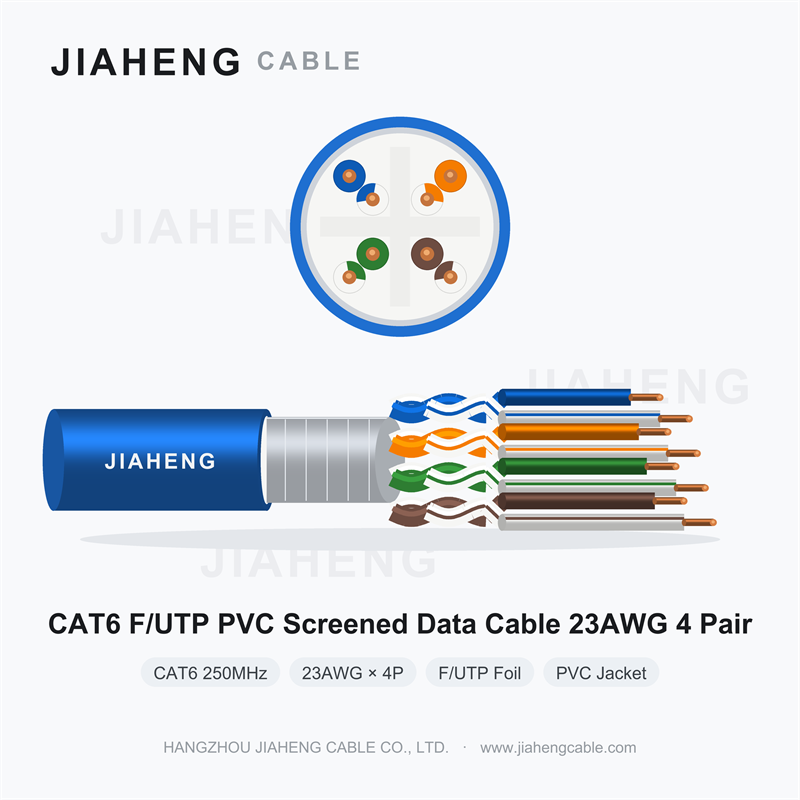
In an F/UTP cable, an aluminium-polyester tape is applied longitudinally over the cabled core, with a tinned copper drain wire held in continuous contact against the metallised surface, and the assembly is then jacketed in LSZH or PVC compound. The individual pairs remain unshielded, which is why the designation reads foil around unshielded twisted pairs.
| Feature | U/UTP Cat6 | F/UTP Cat6 |
|---|---|---|
| Pair screen | None | Overall foil tape with drain wire |
| Noise rejection mechanism | Pair balance and lay-length tuning | Balance plus electrostatic barrier |
| Bandwidth | 250 MHz | 250 MHz |
| Jacket options | LSZH, PVC | LSZH, PVC |
| Termination hardware | Standard unshielded jacks and panels | Shielded jacks and panels with drain bonding |
| Outside diameter | Typically smaller | Slightly larger due to tape and drain |
| Relative material cost | Baseline | Higher |
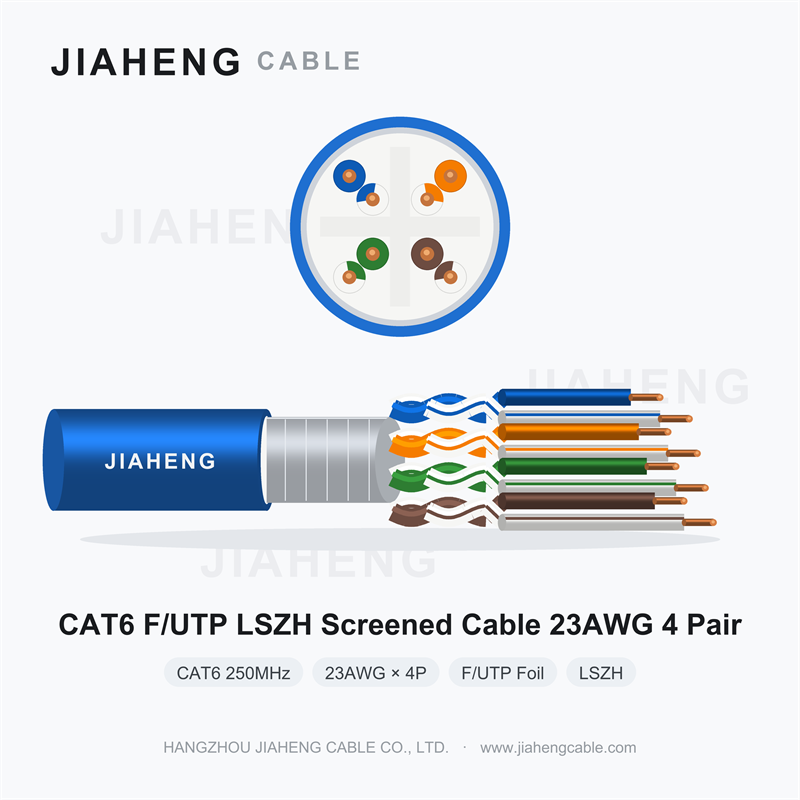 CAT6 F/UTP LSZH Screened Cable, 23AWG 4-PairFoil-screened Cat6 construction with drain wire and LSZH jacket, suited to high-EMI routes when screened connectors, panels and wide-area bonding are properly earthed.View Product →
The tape behaves as a capacitive barrier: it intercepts electric-field energy before it reaches the pairs and diverts it toward the drain wire. Crucially, that performance is not a property of the tape alone. It is a property of the whole bonded path, from the cable through the connector, the patch panel, the rack and the building bonding network. A screen that is cut short, folded back or terminated through a long pigtail offers very little at high frequency.
Variable-frequency drives, servo amplifiers, switch-mode power supplies and fluorescent ballasts generate strong electric fields. Without a barrier, those fields induce small displacement currents on the conductors, and any imbalance converts part of that common-mode energy into a differential signal that competes with the data. A bonded foil screen shunts most of the displacement current to the reference conductor before it reaches the pairs. This is the mechanism that justifies F/UTP in cabinets full of drives and contactors.
At power and harmonic frequencies, magnetic fields pass through a thin aluminium tape with little attenuation. Screening helps only marginally here; what actually protects the link is the twist of each pair and the symmetry of the conductors. This is why a well-made U/UTP cable can perform flawlessly beside transformers and motors, while a poorly balanced shielded cable cannot. Shielding complements balance, it does not replace it.
Above roughly 30 MHz the barrier works mainly by reflection and absorption, and its effectiveness is expressed as transfer impedance: the lower the value, the better the screen. That figure collapses if the connection between tape and connector is inductive. Full 360-degree contact at the jack, short drain tails, shielded patch panels bonded to the rack, and equipotential bonding of the rack itself are all part of the electrical design, not optional extras.
Even a shielded cable converts some common-mode noise into differential noise, particularly where the pairs are imperfectly matched. The practical benefit of F/UTP is therefore an increase in noise margin rather than immunity to every disturbance. In a link running close to its bit-error-rate limit, that additional margin is often the difference between a stable 10GBASE-T channel and intermittent retraining.
Because both cables share the Cat6 bandwidth target, the interesting differences appear in bundling behaviour, thermal performance under PoE and installation practice rather than in headline category figures.
| Parameter | U/UTP Cat6 | F/UTP Cat6 |
|---|---|---|
| Alien crosstalk in dense bundles | Higher, limits bundle size | Lower, allows tighter fill |
| Electric-field immunity | Depends on balance only | Balance plus bonded screen |
| Low-frequency magnetic fields | Handled by twist symmetry | Marginal improvement |
| Consequence of a poor bond | Not applicable | Screen can act as an antenna |
| Installation labour | Lower | Higher, bonding and continuity checks |
| Typical fit | General office and home LANs | Industrial, clinical, dense data halls |
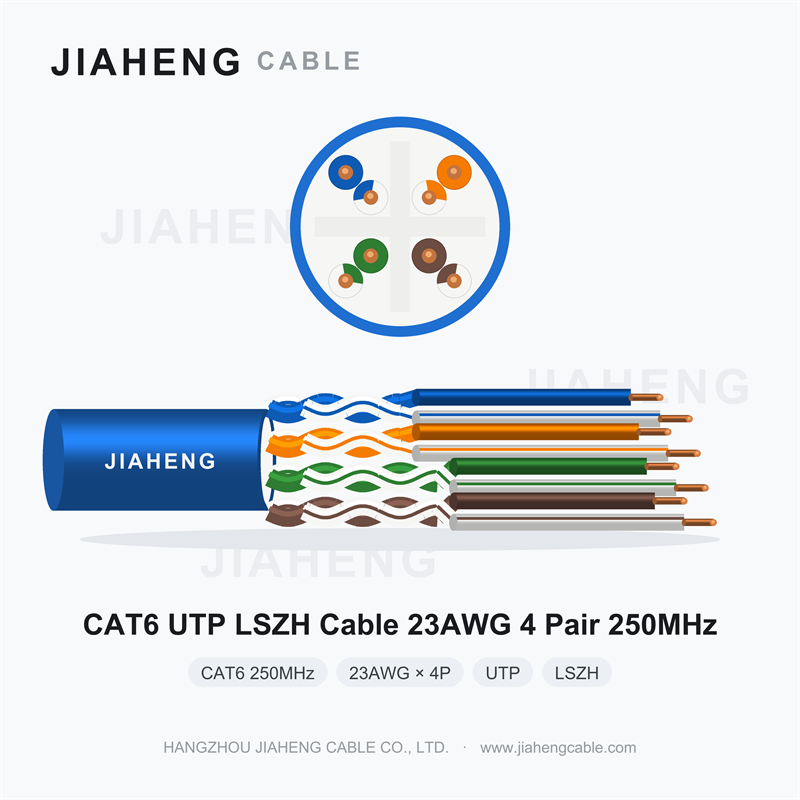 CAT6 UTP LSZH Ethernet Cable, 23AWG 4-PairUnshielded Cat6 cable for ordinary office, education, healthcare and light commercial cabling, with LSZH jacket and 23AWG copper for PoE and Gigabit channels.View Product →
Alien crosstalk deserves particular attention. When dozens of cables are pressed together in a tray or a cabinet, signal leaks from one cable into its neighbour. The foil in an F/UTP design attenuates that coupling, which is why shielded systems can be installed at higher fill ratios and in tighter trays without violating channel limits. For a data hall where containment space is at a premium, this can matter as much as EMI immunity.
Thermal behaviour under Power over Ethernet follows a similar logic. A screen does not increase current capacity and does not remove the need to calculate bundle heating, but it does spread heat slightly and, more importantly, keeps external noise away from the link while the conductors run warmer and noisier. Any decision to move up a category should be made on channel-length and application grounds, as explained in the comparison of Cat5e, Cat6 and Cat6A cabling.
Where cables share trunking with motor feeds, welding equipment or inverter outputs, the electric-field component is high and continuously present. F/UTP is the defensible default, provided the plant uses shielded outlets, bonded cabinets and a documented equipotential bonding system. If the bonding system cannot be verified, a well-installed U/UTP channel on dedicated containment may actually outperform a shielded system that floats.
Imaging suites, electrosurgical units and radiotherapy equipment create bursts of broadband noise. Foil-screened cable, combined with low-smoke zero-halogen jackets for fire safety, is a common specification. The screen also reduces emissions from the cabling itself, which helps where sensitive instrumentation sits nearby.
In a dense hall the dominant threat is often internal rather than external. Alien crosstalk between adjacent cables, plus noise from switch-mode power shelves, makes the shielded option attractive, and the higher permissible fill ratio helps with airflow. Cable routes and topology options are outlined in the data center cabling solutions overview. Where 10GBASE-T over 100 metres is required, a Cat6A foil-screened construction is the natural upgrade.
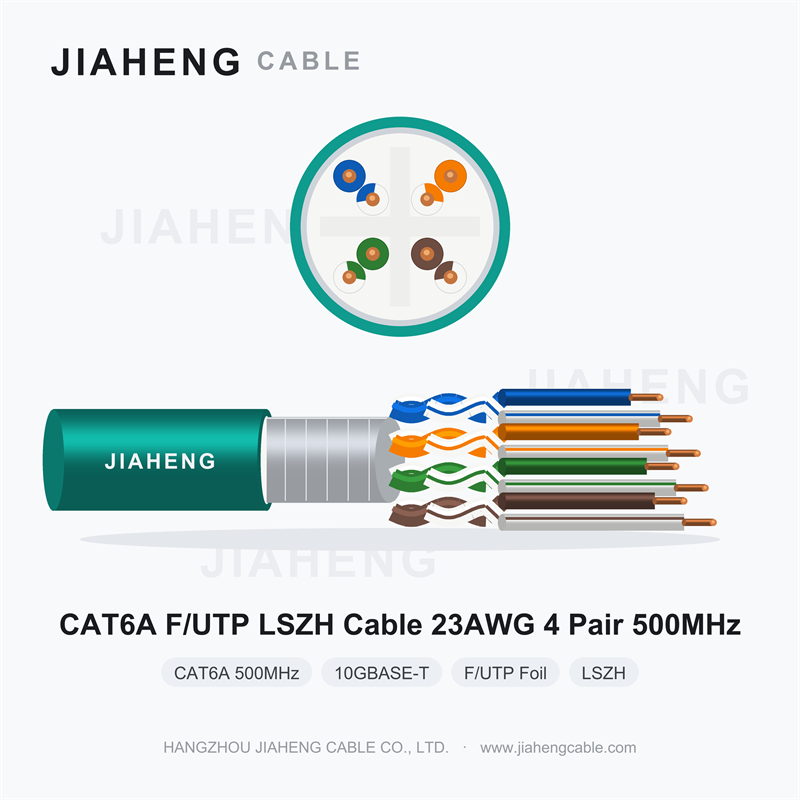 CAT6A F/UTP LSZH Cable, 23AWG 4-Pair, 500 MHzFoil-screened Cat6A cable for 10GBASE-T over 100 m channels and dense installations, requiring shielded termination and bonding to preserve alien-crosstalk performance.View Product →
Rooftop cabinets and radar-adjacent buildings see strong ambient fields. Here the foil screen plus a properly bonded enclosure is the safer choice, and the drain wire should be tied into the cabinet earth at the entry point. Jiaheng Cable supplies both an F/UTP and a U/UTP Cat6 LSZH 23AWG design, so the decision can be made on site conditions rather than on availability.
Rule of thumb: unshielded Cat6 in a bonded, well-separated route will beat shielded Cat6 in a floating, poorly terminated one. The screen multiplies the quality of the installation; it does not compensate for a weak one.
No. Both are 250 MHz Cat6 cables and support the same Ethernet applications over the same distance. The shielded version offers greater noise margin and lower alien crosstalk in bundles, which improves reliability rather than headline speed.
In permanent building cabling the screen is normally bonded at both ends into the equipotential bonding network through shielded hardware. Single-ended bonding is a special case that should follow the EMC plan and the applicable standard rather than habit.
It is not recommended. Mixing breaks screen continuity, creates impedance discontinuities and complicates testing. Keep one construction type across a permanent link and its patch cords.
No. IEEE 802.3bt does not mandate a screen. Shielded cable can be used, but bundle heating calculations and bonding still apply, so the choice should follow the noise environment rather than the power level alone.
The choice between F/UTP and U/UTP Cat6 comes down to a simple question: can the installation guarantee a bonded, continuous screen path? Where the answer is yes and the environment is electrically aggressive, foil shielding pays for itself in stability and in bundle density. Where the answer is uncertain, a balanced unshielded cable on clean routes remains a robust and cost-effective solution. Site surveys, containment planning and post-installation testing decide more outcomes than the tape ever will.

 sales@jiahengcable.com
 +86-19357267601

 Heziwu, Shuangyuan Village, Linglong Subdistrict, Lin'an District, Hangzhou City, Zhejiang Province, P.R.China
Copyright © Hangzhou Linan Jiaheng Cable Co., Ltd. All Rights Reserved Custom Industrial Wire and Cables Suppliers
