

 English
 Industry News
Home / News / Industry News / How to Choose the Right Composite CCTV Cable for Long-Distance Security Surveillance Systems

Content
A composite cctv cable bundles a 75 Ω coaxial video line and a parallel pair of DC power conductors inside one jacket. Installers also call it a siamese cctv cable, a CCTV power and video cable or a coaxial power combo cable. All of these names describe the same idea: one pull delivers both picture and power to the camera. On a short run inside a shop, the convenience is obvious. On a perimeter run of 150 m or more, the construction details decide whether the camera shows a crisp picture at night or reboots every time the infrared lamps switch on.
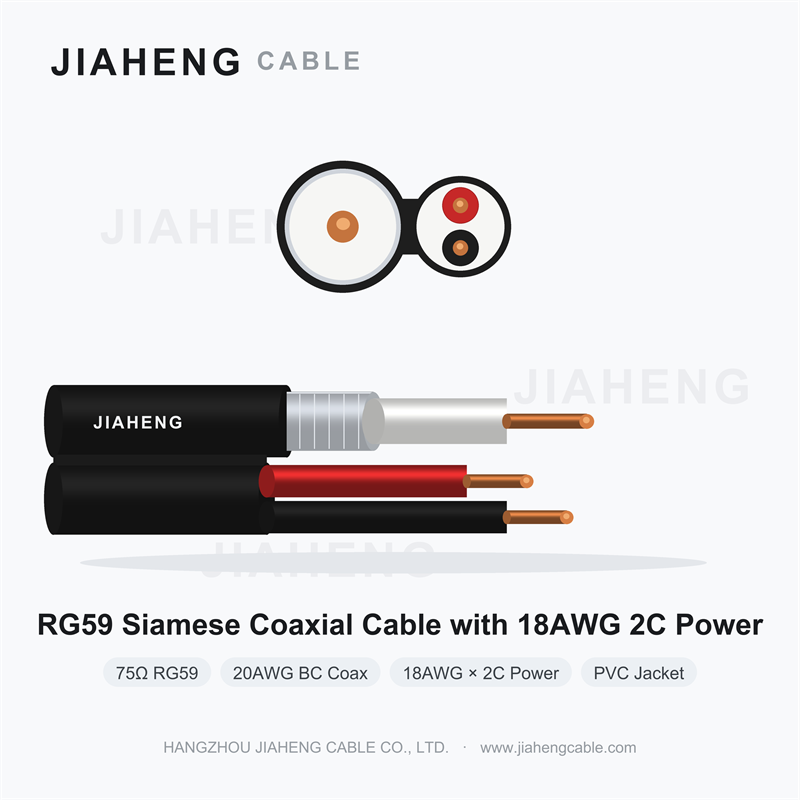
An RG59 composite cable joins one coaxial video core and two power conductors in a single sheath.
Video attenuation grows with both frequency and length. A 1080p analog HD signal occupies far more bandwidth than a legacy 960H picture, so a cable that once reached 500 m may now deliver a clean image at roughly 300 m. The chart shows indicative planning values for 1080p analog HD over copper conductors. Always confirm them against the attenuation table in the datasheet of the cable you intend to buy.
Indicative maximum video run in meters, 1080p analog HD.
Power usually fails before video does, which is why the shorter of the two limits always wins. Three numbers anchor most design decisions.
An RG59 composite cable remains the default for most commercial projects because it is flexible, easy to terminate and inexpensive per meter. It handles typical building runs without trouble. When the distance stretches, a larger center conductor and thicker dielectric reduce loss, which is the reason RG6 and RG11 versions exist.
| Type | Center conductor | Loss at 100 MHz per 100 m | 1080p reach | Typical use |
|---|---|---|---|---|
| RG59 | 0.81 mm | about 11 dB | about 300 m | Buildings, shops |
| RG6 | 1.02 mm | about 7 dB | about 450 m | Campuses, car parks |
| RG11 | 1.63 mm | about 5 dB | about 650 m | Long perimeters |
If every camera sits within 250 m of the recorder, an RG59 core is usually the sensible choice. It leaves a margin of around 15 to 20 percent for connectors, patch points and aging.
Keep in mind that larger coax is stiffer. A minimum bend radius of about ten times the cable diameter is a safe rule, and RG11 cables need wider pulling corners and larger junction boxes.
Current travels out to the camera and back again, so the electrical loop is twice the cable length. Resistance in that loop turns into lost voltage, and the camera sees whatever remains. Typical copper resistance is about 21 Ω per kilometer for 18 AWG, 33 Ω for 20 AWG and 53 Ω for 22 AWG.
Voltage drop as a share of a 12 V supply, 0.3 A camera load, copper conductors.
The result is sobering. At 100 m, a 22 AWG pair already loses more than a quarter of a 12 V supply, while an 18 AWG pair stays near 10 percent. Infrared lamps, heaters and motorized lenses raise the current further, so a camera that works at noon can fail at night.
Two cables with the same printed gauge can behave very differently. Copper-clad aluminum carries a thin copper skin over an aluminum core, and its direct current resistance is substantially higher than that of solid copper. The chart compares relative resistance for the same diameter.
Relative DC resistance at equal diameter, bare copper set to 100 (approximate).
Higher resistance means more heat and more voltage drop, and the aluminum core is also more brittle. It can crack when bent repeatedly and corrodes faster at terminals. Several project specifications therefore require pure copper power conductors, and reputable suppliers state the material openly on the datasheet.
A combined cable is not the answer to every layout. The radar chart rates three common approaches on five practical criteria using a one to five scale. The scores are indicative and reflect typical analog HD projects.
Indicative scores from 1 (weak) to 5 (strong).
RG59 composite wins on installation speed because one pull replaces two, and many crews report noticeably shorter pulling time per camera. RG6 composite stretches the distance and signal quality but costs more and bends less easily. Separate cables remain the most flexible, since power and video can be routed independently, but they double the pulling, labeling and termination work.
For most multi-camera sites, the practical answer is mixed: use RG59 composite for the many short and medium drops, and reserve RG6 or separate runs for the few remote cameras.
The jacket decides how long the cable survives outdoors. Sunlight, moisture, rodents and temperature swings attack the sheath long before they touch the copper.
| Jacket | Best environment | Strength | Watch out for |
|---|---|---|---|
| PVC | Indoor, conduit | Flexible, economical | Cracks in long UV exposure |
| UV-stabilized PE | Outdoor, direct burial | Moisture and sun resistance | Stiffer in cold weather |
| LSZH | Tunnels, public buildings | Low smoke, no halogen gas | Higher price |
A foil layer blocks high-frequency noise, while braid gives low-frequency protection and mechanical strength. A braid coverage of 90 percent or more combined with foil is a solid baseline for sites near motors, lifts and radio equipment. For aerial spans, add a steel messenger wire; for wet ground, ask for a water-blocking layer.
The flowchart turns the earlier sections into a repeatable routine that can be reused for every project.
Six-step cable selection routine.
Consider a perimeter with twelve cameras, the farthest sitting 220 m from the equipment room. Each camera is rated 24 V AC and draws 0.25 A.
The sensible specification is an RG59 composite cable with a copper 18 AWG power pair, a UV-stabilized PE jacket, and a 24 V AC supply.
Good paperwork separates a dependable security camera wire manufacturer from a trader who simply relabels reels. The first purchase should be treated as a technical audit, not a price negotiation.
Keep the sample results on file. They become your benchmark for incoming batches and a reference if a warranty question appears later.
Even a well specified cable underperforms when the installation is careless. On long runs, small mistakes add up: a kinked section here, a poor crimp there, and the margin you designed is gone before the first camera is powered.
Connectors are the weakest point of any coaxial link. A compression connector sized for the exact cable outline keeps the shield continuous and holds impedance steady. Twist-on and soldered joints are far more variable, and field surveys often trace the majority of picture faults to the connector rather than the cable itself.
On the power side, avoid wire nuts and loose screw terminals. Use crimped ferrules or sealed connectors, and apply anti-oxidation treatment where the pair meets a terminal block outdoors. A single high-resistance joint can add the same loss as another fifty meters of cable.
Long outdoor cables act like antennas for lightning and switching surges. Install video and power surge protectors at both ends of any run that leaves the building, and bond the shield to a clean earth point at a single location to prevent ground loops. In exposed areas, keep the cable inside metallic conduit or buried below the frost line, and separate it from any lightning down conductors.
Camera resolution tends to rise every few years. A cable that carries 1080p comfortably today may be stretched by a higher bandwidth format tomorrow. When the budget allows, specify one grade above the current requirement, such as RG6 where RG59 would just meet the distance. The extra material cost is small compared with the labor of pulling new cable through finished walls and trenches.
Also leave spare capacity in the power budget. A recorder room supply sized exactly for today's cameras leaves no room for heaters, wipers or additional lamps. A margin of 25 percent on total current is a practical target, and it protects the supply from running hot during summer peaks.
It depends on the video core and the power design. An RG59 core usually reaches about 300 m for 1080p analog HD, RG6 about 450 m and RG11 about 650 m. Power may limit the run sooner than video.
No. IP cameras need twisted pair Ethernet cable. The coaxial core is designed for analog and HD analog formats, although a media converter can adapt coax for some network links.
Most designers keep the drop under 10 percent of the supply voltage, measured at full load with the infrared lamps on. Always check the minimum input voltage in the camera datasheet.
It can work on very short runs, but its higher resistance, brittleness and terminal corrosion make it a poor choice for long distances. Pure copper is the safer specification.
Stranded conductors tolerate bending and vibration better and suit pulling through conduit. Solid conductors are slightly cheaper and fine for fixed, protected routes.
Only if the jacket is rated for direct burial, normally UV-stabilized PE with water-blocking protection. Standard indoor PVC cable should always be placed inside conduit.
Sometimes. Beyond the practical reach of the chosen coax, an equalizing amplifier or active receiver can restore high frequency detail. It adds a powered device in the field, so a thicker coax is usually the simpler and more reliable fix.
Compare the printed meter marks along the jacket at both ends, and weigh the reel against the expected weight per kilometer. Reputable manufacturers state the length tolerance in their datasheets and accept sample verification before bulk delivery.

 sales@jiahengcable.com
 +86-19357267601

 Heziwu, Shuangyuan Village, Linglong Subdistrict, Lin'an District, Hangzhou City, Zhejiang Province, P.R.China
Copyright © Hangzhou Linan Jiaheng Cable Co., Ltd. All Rights Reserved Custom Industrial Wire and Cables Suppliers
